Contents
Introduction
- The fascial chain test shows which myofascial chains are dysfunctional.
- The height of the stool is ideally determined by the length of the patient’s upper arm.
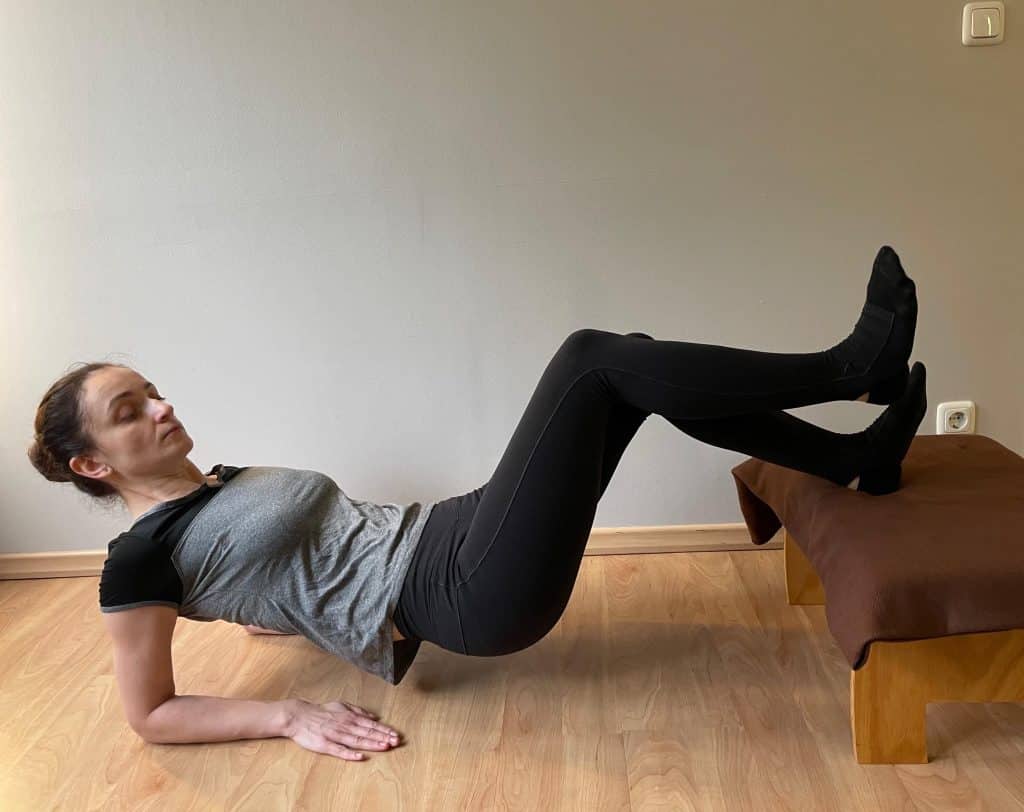
- Shoulders, hips, and feet are aligned, and the body is parallel to the floor.
- Foot holding the weight on the stool determines which line is to be tested
- The foot should not be raised more than 10 cm, otherwise, rotation in the hip will occur.
- It is important that the correct form is maintained throughout the entire test.
- For healthy individuals between 18-65 years, each individual test should be performed for 30 seconds.
Five muscle chains are tested
Posterior Muscle Chain: Hips must remain level, toes pointed up, feet not rotated
Posterior Stabilization Line: Hips must be at shoulder height, knees bent, toes pointed up, feet not rotated
Anterior Muscle Chain: Body must be parallel to the floor, feet flat on the stool, body straight, legs straight without twisting
Lateral Muscle Chain: Head, shoulders in alignment with the rest of the body
Medial Muscle Chain: Head, shoulders in alignment with the rest of the body, big toe and heel of the lower foot should touch the stool
Recording the Test Results
WH: Repetition (The test can be repeated in one week) Under L/R, the time until the test could be performed is entered. Under Area, it is noted whether pain and uncomfortable sensations may have occurred in this area.
Conclusions
- The two weakest fascial exercises can be performed daily as homework, but only if the score achieved is 5 or higher.
- With a test score of 5, the respective exercise should be performed 4×4 seconds daily as homework
- With a test score of 6, the respective exercise should be performed 5×5 seconds as homework
- With a test score of 7 and above, the respective exercise should be performed 6×6 seconds as homework.
- If the fascial score is below 4, only pre-stool exercises should be performed as homework, i.e., exercises on the floor.