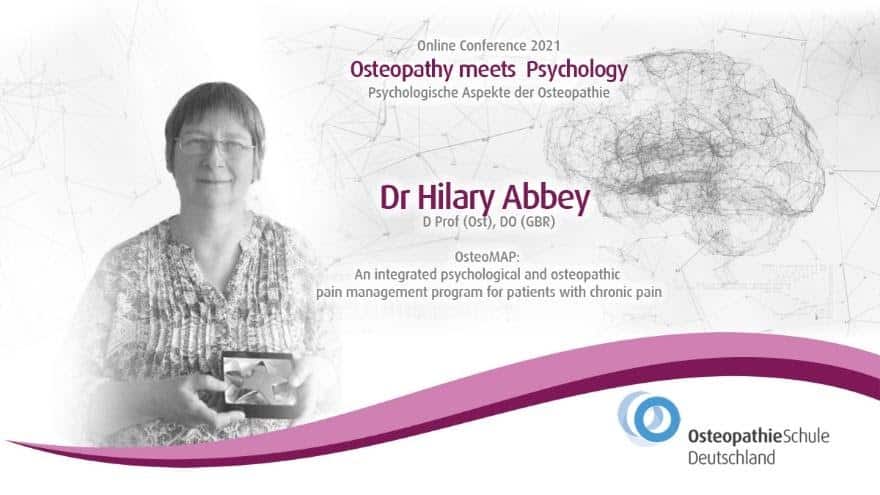
Dr Hilary Abbey has been an osteopath for over 40 years. She is Project Leader at OsteoMAP and an Associate Professor at the University College of Osteopathy in London. She leads the research there. “My experience is that ACT (Acceptance and Commitment Therapy) effectively helps our patients develop psychological flexibility in responding to pain that may not be ‘fixable’ with osteopathy alone.” On November 20, you can see Dr Abbey give a lecture at our ONLINE CONFERENCE 2021 : “OsteoMAP: An integrated psychological and osteopathic pain management programme for patients with chronic pain”REGISTER NOWhttps://web.cvent.com/event/e52b2684-e9a5-4ef1-9e61-f3eb9bc1f042/summaryYou can learn more about Dr Hilary Abbey in our interview:HOW LONG HAVE YOU BEEN PRACTISING OSTEOPATHY, AND WHAT IS YOUR MOST IMPORTANT MOTIVATION FOR BEING AN OSTEOPATH? WHAT HAS BEEN YOUR MAIN INTEREST IN OSTEOPATHY OVER THE YEARS, AND HOW HAS IT CHANGED OVER TIME?I graduated from the British School of Osteopathy (now UCO) in 1979. At that time, osteopathic training focused on structural diagnoses, and I soon realised that biomechanical knowledge was not sufficient to help many of the patients I treated with complex, long-term health problems. To improve my skills and provide more effective biopsychosocial osteopathic care, I decided to train as a social worker and later as a counsellor, which led to a strong interest in working with patients with chronic pain.WHAT POTENTIAL DO YOU SEE IN INTEGRATING MINDFULNESS INTO OSTEOPATHY?I began learning more about mindfulness when I worked with a colleague from clinical psychology at UCO to develop a new psychologically informed course in osteopathic pain management. Her area of expertise is Acceptance and Commitment Therapy (ACT), a form of Cognitive Behavioural Therapy (CBT) that includes secular mindfulness exercises. Osteopaths who want to use ACT must also be willing to apply it in their own lives, so I had to start practising mindfulness, even though I resisted and found it challenging. I am aware that mindfulness is not suitable for everyone, but I believe there are significant potential benefits in becoming more aware of ourselves and our bodies. My experience is that ACT effectively helps our patients develop psychological flexibility in responding to pain that may not be ‘fixable’ with osteopathy alone. YOUR RESEARCH FOCUSES ON MINDFULNESS- AND ACCEPTANCE-BASED PROGRAMMES IN OSTEOPATHY—WHAT CLINICALLY RELEVANT FINDINGS FROM YOUR RESEARCH COULD BE IMPORTANT FOR OSTEOPATHS? AT OUR ONLINE CONFERENCE, YOU WILL SPEAK ABOUT “OSTEOMAP: A BEHAVIOURAL THERAPY AND OSTEOPATHIC PROGRAMME FOR PAIN PATIENTS”. WHAT CAN PARTICIPANTS EXPECT FROM YOUR LECTURE? In my lecture, I will discuss the reasons for developing the OsteoMAP course and the results of the three-year research study. I will also talk about the benefits and challenges of psychologically informed treatment for patients with persistent pain and present practical ideas on how osteopaths can adapt these concepts for their own practice.COULD YOU GIVE US A BRIEF OVERVIEW OF YOUR LATEST RESEARCH?The most recent publication on OsteoMAP is Abbey et al. (2020), which presents the final patient outcomes and suggestions for the next phase of research and development. Since then, together with colleagues, I have worked on two papers addressing topics relevant to psychologically informed osteopathic practice: the neurophysiology of touch, mindfulness and interoception (Casals Gutierrez and Abbey, 2020), and the role of medical humanities and narrative medicine in understanding patients’ experiences of pain (Maretic and Abbey, 2020). MORE INFORMATION ABOUT OUR ONLINE CONFERENCE 2021 CAN BE FOUND ON OUR WEBSITEhttps://www.osteopathie-schule.de/online-conference-2021/
English Version
DO YOU KNOW DR HILARY ABBEY?Dr Hilary Abbey has been an osteopath for over 40 years now. She is the Project Leader at OsteoMAP and an Associate Professor at the University College of Osteopathy in London, where she is the Head of Research. “My experience is that ACT is effective in helping our patients to develop psychological flexibility in responding to pain that may not be ‘fixable’ with osteopathy alone.” On November 20th, Dr Hilary Abbey will give a lecture at our ONLINE CONFERENCE 2021 : “OsteoMAP: An integrated psychological and osteopathic pain management program for patients with chronic pain”JOIN NOWhttps://web.cvent.com/event/e52b2684-e9a5-4ef1-9e61-f3eb9bc1f042/summaryLearn more about Dr Hilary Abbey in our interview:SINCE WHEN ARE YOU PRACTICING OSTEOPATHY AND WHAT IS THE MOST IMPORTANT MOTIVATION FOR YOU TO BE AN OSTEOPATH? WHAT WAS YOUR MAIN INTEREST IN OSTEOPATHY DURING THE YEARS AND HOW DID IT CHANGE OVER THE TIME?I graduated from the British School of Osteopathy (now the UCO) in 1979. At that time, osteopathic training focused on structural diagnosis and I soon realised that biomechanical knowledge was not enough to help many of the patients I saw with complex, long-term health problems. I chose to train as a social worker, and later as a counsellor, to increase my ability to offer more effective biopsychosocial osteopathic care and developed an interest in working with patients with chronic pain.WHAT POTENTIAL DO YOU SEE IN INTEGRATING MINDFULNESS IN OSTEOPATHY? I started to learn about mindfulness while working with a clinical psychology colleague at the UCO to develop a new psychologically-informed osteopathic pain management course. Her expertise is in Acceptance and Commitment Therapy (ACT), a form of Cognitive Bahaviour Therapy (CBT) that includes secular mindfulness exercises. Osteopaths who want to use ACT have to be willing to use it in their own lives, so I had to start practising mindfulness even though I was reluctant and found it challenging. I realise that mindfulness does not suit everyone, but I think there are significant potential benefits in becoming more aware of ourselves and our bodies and my experience is that ACT is effective in helping our patients to develop psychological flexibility in responding to pain that may not be ‘fixable’ with osteopathy alone. YOUR RESEARCH CONCERNS MINDFULNESS AND ACCEPTANCE-BASED PROGRAMMES IN OSTEOPATHY – WHAT COULD BE SOME CLINICAL RELEVANT OUTCOMES FOR OSTEOPATHS FROM YOUR RESEARCH? AT OUR ONLINE CONFERENCE YOU WILL TALK ABOUT “OSTEOMAP: AN INTEGRATED PSYCHOLOGICAL AND OSTEOPATHIC PAIN MANAGEMENT PROGRAM FOR PATIENTS WITH CHRONIC PAIN”. WHAT CAN THE PARTICIPANTS EXPECT TO LEARN FROM YOUR LECTURE? My session will explore the reasons we developed the OsteoMAP course and results from the three year research study. I will also talk about the benefits and challenges of using psychologically informed treatment for patients with persistent pain and practical ideas about how osteopaths can adapt these ideas for use in their own practices.COULD YOU GIVE US A SHORT OVERVIEW TO YOUR LATEST RESEARCH PAPERS?The most recent publication about OsteoMAP is Abbey et al (2020), which presents the final patient results and suggestions for the next stage of research and development. Since then, I have collaborated with colleagues on two papers that explore topics that are relevant to psychologically informed osteopathic practice. They are about the neurophysiology of touch , mindfulness and interoception (Casals Gutierrez and Abbey, 2020) and the role of medical humanities and narrative medicine in understanding patients‘ lived experiences of pain (Maretic and Abbey 2020).MORE INFORMATION ABOUT OUR ONLINE CONFERENCE 2021 YOU CAN FIND ON OUR WEBSITE https://www.osteopathie-schule.de/online-conference-2021/