Torsten Liem, Patrick Van Den Heede, Mind-body interdependence in osteopathic treatment, Osteopathische Medizin. 2021; 22 3: 28-32,https://www.sciencedirect.com/
- one in which the mind is dependent on physical parameters, and
- one in which the mind has acquired a relatively independent quality of information, which in turn can interfere with physical factors.
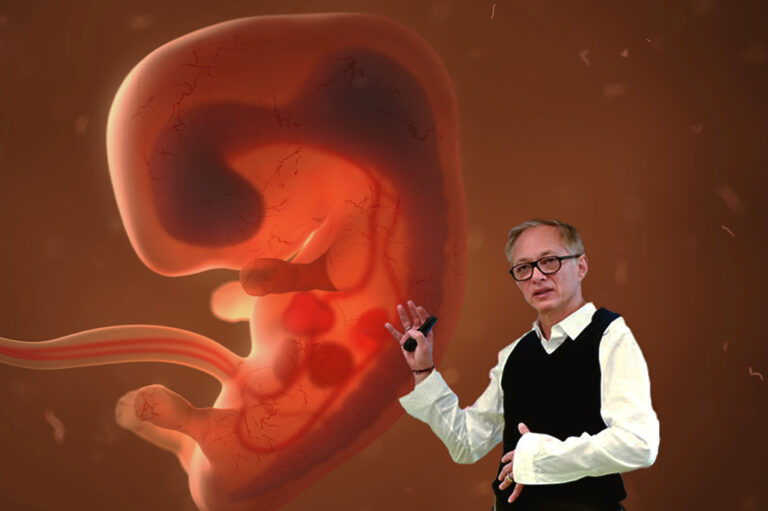
In our view, information can be understood as both a physical and a conceptual, abstract unit of exchange that constellates and interferes with modalities of form (appearance) in certain time scales of evolution. We postulate that these processes are accompanied by an associated, fluctuating process of consciousness in all kinds of forms and evolutions, which at the same time also demonstrates a relative autonomy. In our experience, the respective therapeutic competence, the interferences and interactions of mind and form, taking into account ontogenetic and organogenetic aspects of – as well as phylogenetic and evolutionary influences in – the respective patient have an influence on the processes taking place in the here and now of a treatment interaction.Body conceptWeunderstand the concept of “body” or “embodiment” as an adaptive process of increasing complexity, integrating information into matter and exposing this integrated information to an evolutionary wave pattern of adaptability to an ever-changing and integrative refinement of increasing complexity. In particular, evolutionary brain development (as a body substrate) comes to the fore in the development of humanity, whereby the body concept itself is subject to evolutionary changes in the course of human development, e.g. from an abstract construct to an increasingly concrete body that enables meaningful experiences, accompanied by increasing integration of the perception of both states and processes, also beyond mechanistic perspectives, from the external to the internal, from states to processes, from analysis to holism, from mechanical isolated wholeness to a consideration of systemic interactive context dynamics ([2], following Levin and Solomon 1990). Body-mind relationshipInour view, depending on evolutionary and ontogenetic evidence, body-mind interaction and mind-body interaction should be considered as two successive episodes of ontogenetic differentiation.ontogeny refers to the development of an individual being, as distinct from the concept of phylogenesis. Accordingly, body-mind medicine and mind-body medicine appear as two facets of the same coin, with their depth and healing potential increasing with the identification, differentiation and integration of bottom-up as well as top-down information and processes.In this sense, the specificity of the mind seems to be related to a specific transformation of the implicated matter, the mind begins to become or appear quasi “personalized” when it is associated with a specific form of matter. The following interactions are significant for our understanding of the development of disease and the osteopathic approach in the treatment setting: When energy and matter influence each other, they create an evolutionary pattern of space-time relationship that is specific to that particular form. The mind can be understood as an interactive expression between these two components, which creates an increasing probability of consciousness and eventually awareness, depending on the evolutionary stage, and especially in the treatment of humans, it is essential to us that the mind starts from specified and specialized consciousness and creates and is able to change consciousness.As an end result, we see the emergence of a constantly self-renewing mind that begins to live its own life with increasing relative autonomy (an “original” informed part that now begins to connect with an abstracting tendency of the mind’s attitude, relativizing and emancipating itself from physical limitations). This new potential of the mind also has the ability – albeit always in dependence on interacting dynamics with physicality and life contexts – to influence and reorganize the “matter” of the body. We observe in our osteopathic treatment that as the mind initially evolves through as well as in interaction with an increasing complexity of the physical to grow in depth and meaning and become concrete and expressive, it begins to inform and transform the body via shifting space-time units of consciousness and awareness in the “subtlest and finest components of its constituents”.Accordingly, we see the ontology of mind as a history of the construction and maturation of mind on a genetic and epigenetic landscape of the body’s proto-ontogenesis (preinformed ontogeny), while the phenomenology of mind appears as a history of the condensation of space-time into the subtlest fractals of body-consciousness.In this sense, the body matter first potentiates the maturation of mind, while later the mind matter reorganizes the body matter. In fact, in our view, there is ultimately no separation of mind and body (matter). There is no such thing as separate mind-stuff and body-stuff, i.e. informational transformation is never just body-related, never just mind-related, but dependent on environmental contexts in which the body-mind unit evolves, meaning that each living system depends on how it has evolved and developed in relation to its context. This also means that the possibilities for transformational processes in treatment are determined by a common and combined pattern of interference and expression of the components of body-mind and mind-body interactions that can be traced back to the past on the one hand and relate to the probability of an evolving future on the other.Morphodynamics in osteopathyOn the one hand, evolution is a process of self-transcendence that leads beyond the existing [1], with each new emergence transcending and incorporating its precursors, with the lower setting the possibilities of the higher and the higher setting the probabilities of the lower, and each further evolutionary stage generating greater depth. On the other hand, in its form as a (relatively) autonomous whole, there is a defined telos of this whole. In its capacity as part of another whole, however, it is influenced by a telos outside itself. Attractors thus exert patterns of increased probability and, as formative traits, a kind of drive for development or a kind of pull that “pulls” development in a certain direction. An ascending causality of increasing complexity of the material world goes hand in hand with an equally descending causality of consciousness. Both are an expression of constantly changing information, which simultaneously acts as an impulse generator for these ascending and descending causalities. In this sense, spirit has “chosen” a very select tissue (ectoderm) on which it can create its mental stuff. Embryologically, the brain was virtually built on two other tissues (entoderm and mesoderm) to represent its final form and function. In this respect, the brain acts as a kind of transformer of body tissue into mind tissue. It was created and constructed by an “evidence” of afference. Multiple pathways of afferentation were constructed during its ontogenesis and continue to do so until full maturation. The neurological pathways seem to be the most obvious, but the vascular pathways, for example, are at least as informative, if not more so initially, and during neurological maturation (up to the first 22 years of life) a synergistic interference field is established with the maturing immunological field (up to the age of 10). It is therefore not surprising that neurology and the immune system are functionally linked in the differentiation between self and non-self. Evolution shows a direction that is characterized by increasing differentiation, diversity, complexity and organization [2]. This can be seen, for example, in how all the information just mentioned is initially stacked in ordered and subordinate areas of the brain and is later gradually combined in a more complex way and is expressed, among other things, in an increasing internalization of the otherworldly as well as the inhibition and relativization of older brain structures by younger ones, such as the limbic system by the prefrontal cortex or the brain stem by the midbrain. Regulative or dysfunctional influences of social systems, norms, rules and culture on prefrontal activities and functions, which can be examined in an increasingly differentiated manner (which was not yet possible at the time osteopathy was developed), must also be taken into account. neuronal networks are themselves combined and form networks over networks until an enactive brain is formed. This means that the brain, body and context (environment) interact dynamically with each other and are in constant relation to each other and can only be understood from this. Finally, neuronal activity is so complexly wired that its activity generates a subtle field coherence of frequency waves capable of creating images of representations of the mind. The mind arises on the basis of a frequency coherence that is itself dependent on a subtle electrical and electromagnetic brain field organization.Thus, in our view, the brain field organization is characterized by several properties:
- It organizes a memory field.
- It progressively creates a memory of the “self”.
- It creates the possibility or probability of free will.
- It begins to control the “intention” that leads to the cognitive competence of creating probabilities about the world.
The brain has developed at different levels of functionality. We distinguish between
- a survival brain,
- an emotional brain and
- a cognitive brain.
The net expression of “free will” is probably a subtle combination of these three qualities. Sometimes intention is more strongly charged by unconscious drives than by conscious ones, even though we have the impression that our interaction takes place in the conscious field. Intention appears to be a “thought movement” based on a subtle combination of unconscious drives that align with the conscious field of actual interaction.In this sense, the neurocognitive brain and its functional organization are dependent on a variety of influences.The frontal brain field of intention and decision making is constantly informed by the limbic integrative brain field, while being able to simultaneously relativize and inhibit it. This field interferes reciprocally with all convergence zones that are scattered over and in the brain surfaces and with all sensory, sensorimotor and interoceptive inputs that enter the limbic system. in our view, it is particularly important to note therapeutically that long-standing patterns – be they tissue, psychological, neuroendocrine, metabolic, immune or postural and behavioral patterns – become new stabilities and dysfunctions that do not simply dissolve just because the conditions for their emergence have disappeared! Specific strategies are required to resolve them. Borderline experiences as triggers for mind-body desynchronizationChallenges, stress and other borderline experiences in life can, on the one hand, enable us to grow by acquiring new skills, forming new brain circuits and developing new perspectives. However, it can happen that challenges are too fast, intense or complex and overwhelm us and we are not able to react appropriately, but on the contrary, the experience may be characterized by loss of control, helplessness and hopelessness and leave lasting effects in the mind-body interdependence. Mind-body influence in treatmentItis important to note that free will and intention are “controlled” by subconscious levels of consciousness. The part that could be defined as free will is the seemingly conscious part of intention, which is interpreted as being organized by the “self”. The same reasoning can be applied to “thinking”. If one knows that the part that one thinks during a thought process is only the “visible” part of the complete thought that started half a second earlier, then one should consider the possibility that at least parts of a thought take place on an unconscious or preconscious level.this provides for two possibilities:
- The unconscious part of a thought process is related to the organization of the body field and its subsequent afferent tonality (e.g. what organizes the final coherence of certain brain areas). Repeated experiences, familial socialization and attachment patterns, sociocultural interpretations, pre-, peri- and postnatal experiences, the extent to which we have been confronted with positive, tolerable or toxic stress in life, neuroendocrine and neurovegetative stress axes, etc. influence these unconscious processes.
- The conscious part of thinking actively interacts with the body field organization, partly through the unconscious drives behind “free will” and “intention”.
It is now clear that “thinking” is not as free as one might “think”. However, this has the advantage of saving energy and resources, as not every experience has to be analyzed by means of complex reflection.
- First, by the body actively participating in the mind process by providing the supportive cues for all the cognitive and physiological levels necessary for a sharp expression of the mind’s “free will”.
- Secondly, the subconscious undercurrent – including information storage by the cellular system, which functions as a tensegrity structure, among other things – through which unconscious parts of the mind influence the vegetative and neuroendocrine balance of the body.
It is precisely this influence that impairs the body’s balance and its homeostatic adaptability. In this sense, somato-energetic-psychic dysfunctions are accompanied by physiological changes, energetic phenomena, physical experiences including neurovegetative signs as well as emotional impulses and mental interpretations. For example, emotional stress in childhood, especially in early childhood (e.g. in the form of abuse, neglect, injury or events that violate boundaries), can lead to certain strategies whereby loyalty laws are applied in order to ensure survival and continue to receive unconditional love from parents, while at the same time subordinating physical needs (= survival at the expense of relative mind-body synchronization).Clinically relevant conclusion One’s own inner awareness, coupled with the ability to co-regulate, is closely linked to the perception, understanding, confrontation, acceptance and integration of these contents of consciousness, experiences and somato-energetic-psychic dysfunction patterns, as well as to the competence to support patients in approaches to psychosomatic osteopathy. This includes the perception of multiple dynamic interactions of tissue patterns, bodily sensations, neurovegetative arousal, endocrine, metabolic and immune activity, emotions, mentalizations and belief patterns in the concrete everyday life of our numerous life relationships [3]. Thus, osteopathic treatment could promote a state of equilibrium, a release of the bound forces in somato-energetic-psychic tension patterns, by enabling the “mind-body stuff” to clarify its relationship to each other [3].By “inviting” the aspects, forces and worlds of experience associated with the dysfunction in certain ways – which previously led a life of their own relatively separate from the whole or were disregarded, suppressed, repressed or only fragmented and incompletely integrated -If the dysfunctional pattern in a temporally and spatially limited mind-body interaction in the patient changes, the relationship of the whole and the context dynamics can change. This in turn can potentially lead to further changes in the organism. This process begins during the therapeutic interaction, but above all also takes place after the consultation, in the treatment-free interval.Additional informationV.d. Heede, P: The emotional landscape in the osteopathic field. (expected early 2022)Liem T. Psychosomatic osteopathy. Munich: Elsevier; in print (expected early 2022)Course series: Psychosomatic Osteopathy:Basic 1: 29.04.-01.05.2022, Basic 2: 24.06.-26.06.2022 at the OSD in HamburgPsychosomatic Osteopathy, advanced: 15.-18.09.2022 at the OSD in HamburgLiterature
- Jantsch E. The self-organization of the universe. Munich: Hanser; 1992
- Liem T. Paradigms of healing. In: Liem T. Van den Heede P (eds) Foundations of morphodynamics in osteopathy: an integrative approach to cranium, nervous system, and emotions; 1st ed.Pencaitland: Handspring Publishing Limited; 2017
- Liem T. Psychosomatic osteopathy. Munich: Elsevier; in print (expected early 2022)