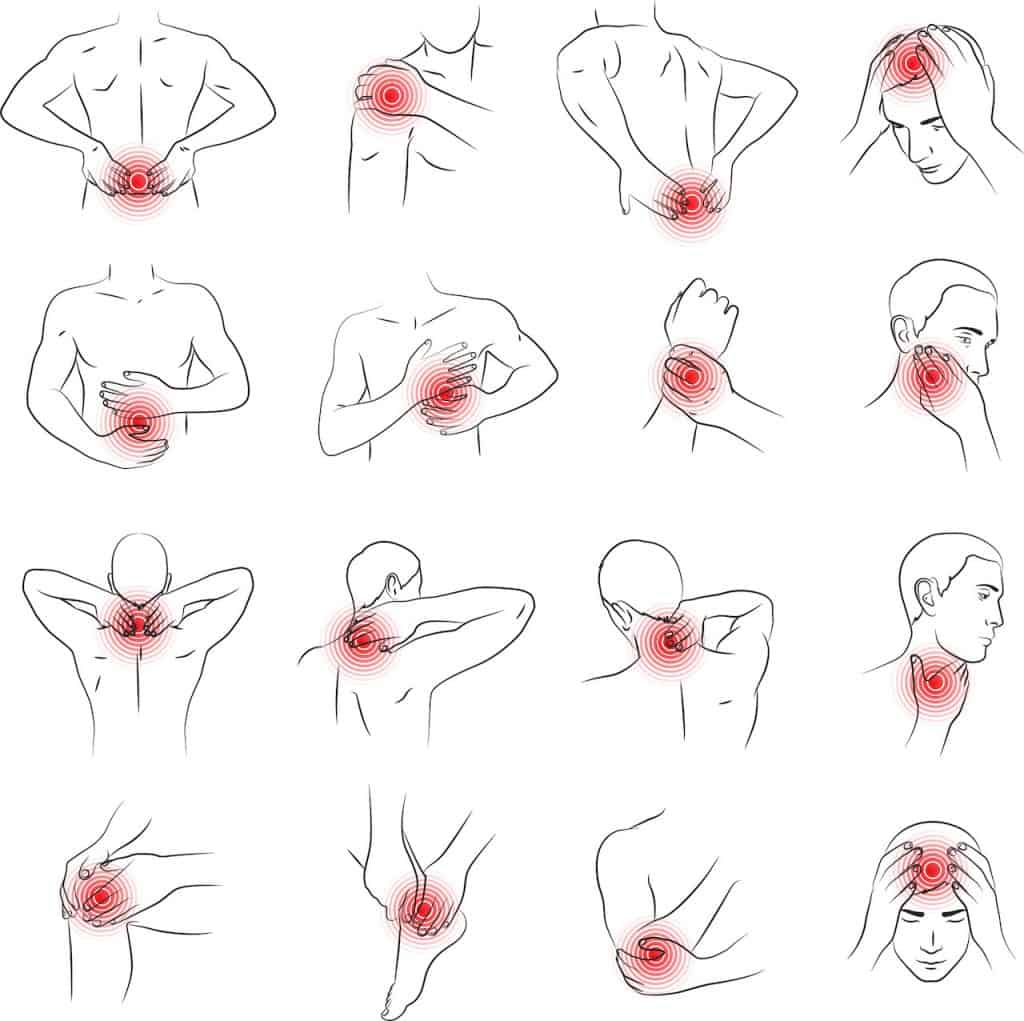
Acute or chronic pain affects several million people worldwide each year, leading both to a significant personal disease burden and to immense healthcare costs within the medical system.
What Is Pain?
Pain is defined as a complex sensory perception mediated by specialized receptors of the peripheral nervous system. The stimulus (in the case of pain, referred to as noxious stimuli) is transmitted via various classes of nerve fibers to the central nervous system (CNS), where it is ultimately processed and interpreted in the brain. The individual’s psychological evaluation of pain plays an important role in the actual perception of pain. Thus, there are different pain qualities: the affective component (“distressing,” “annoying”) and the sensory component (“burning, stabbing, pulling,” etc.). Furthermore, a distinction is made between thermal (heat/cold), chemical (inflammation, acids, toxins), and mechanical (pressure, injury) noxious stimuli.
Acute pain without adequate treatment can also become chronic, as the body possesses a kind of “pain memory.” When pain occurs repeatedly, hyperexcitability of the nerve fibers develops, leading to more intense and prolonged pain perception. Therefore, early and appropriate pain therapy is so important (Schaible and Radbruch 2016).
How Can Pain Be Measured?
As outlined above, pain represents a subjective perception, which makes quantitative assessment difficult. However, there has always been an interest (as with other clinical symptoms) in making pain measurable. Therefore, pain is measured using subjective questionnaires or scales that patients complete themselves. The most commonly used are the Visual Analog Scale (VAS), the Numerical Rating Scale (NRS), and the Verbal Rating Scale (VRS). Objective measurement using a technical device or similar is still impossible to this day.
The decision as to which pain measurement instrument is appropriate for a given study design depends on the study objectives and research methodology and should be carefully considered and documented. In osteopathic research, no uniform osteopathy-specific pain measurement instrument has been established to date. Developing such an instrument could be an essential step in supporting future research (Zanoli et al. 2002), as translating data from self-reported questionnaires into useful patient information presents a challenge.
What Does This Mean for Osteopathy?
Osteopathic research is still in its infancy compared to other research fields. The term “osteopathic manipulative treatment” (OMT) encompasses all techniques individually tailored to patients. To date, OMT has been primarily investigated as an intervention for pain-related conditions. Low back pain, neck pain, and headaches have been the most studied (Steel et al. 2017). In addition to pain reduction, the goal of osteopathic treatment is also to improve quality of life, reduce workplace absenteeism, promote productivity, and incorporate additional cultural and socioeconomic factors into therapy.
OMT thus represents an alternative or complement to standard treatment, which consists of medication, exercise, and sometimes cognitive behavioral therapy.
However, to establish osteopathic manipulative treatment as a clinical treatment option, further high-quality randomized controlled trials, systematic reviews, and meta-analyses are needed to consolidate its efficacy and effectiveness for pain conditions and other symptoms. In this context, it is also important, for example, to use the appropriate pain measurement instrument and to justify the choice.
Last year, the first critical review article was published in a renowned medical journal evaluating the use of measurement systems to quantify pain intensity in osteopathic interventions. As described above, a variety of different pain scales are used in osteopathic research, with the criteria for selection not always clearly defined or not stated.
The researchers’ objective was to compare the different questionnaires and analyze the reasons for selecting a particular questionnaire.
For this purpose, a systematic literature search was conducted in seven medical databases. Randomized controlled trials (RCTs) investigating the efficacy of OMT in reducing pain intensity were included, and the risk of bias was assessed. A total of 26 studies were included in the review.
What Results Did the Systematic Review Yield?
- All studies used a subjective pain scale
- In over 80% of studies, pain was the primary outcome
- In approximately 80% of studies, OMT was efficacious/effective
- The Visual Analog Scale (VAS) was (with modifications) by far the most frequently used
- 15 out of 26 studies (=57%) did not provide adequate justification for the choice of pain measurement instrument
- The average risk of bias was 2.85 on the JADAD scale, indicating moderate study quality
- In some cases, no clear information was provided regarding the timing of pain intensity assessment
Furthermore, the authors provide additional background information on the various pain measurement instruments:
Literature from 2011 concluded that the Visual Analog Scale (VAS), the Numerical Rating Scale (NRS), and the Verbal Rating Scale (VRS) are all valid and reliable for measuring pain intensity, which was reconfirmed in 2018.
The VAS was generally rated as more difficult than the others because paper and pencil are used for completion and patients must draw a vertical line on the VAS scale themselves. This requires a clear understanding of the task as well as independence, and the VAS is therefore only recommended to a limited extent for older people and individuals with cognitive impairments or communication problems. Additionally, evaluation is very time-consuming due to the measurement required.
The NRS represents a practical alternative, as it can be administered verbally and thus also by telephone by the treating practitioner. With the NRS, pain intensity is recorded by indicating a numerical value on a segmented scale, which facilitates interpretation, as a higher value indicates higher pain intensity.
A study by Nio Ong and colleagues also reported that the different interpretations of affective pain components for the individual should be considered in pain therapy and that a multi-method approach could lead to more patient-centered pain research. Osteopathy can certainly make a valuable contribution here if the quality of osteopathic RCT studies is improved with regard to risk of bias and information on reasons for using a measurement instrument. This would enable osteopathic research, with its positive results on efficacy, to convey an even stronger message.
In summary, the differences in the use of the various scales must be carefully considered and the choice of a specific measurement instrument should urgently be justified (Santiago et al. 2020).
Literature
Santiago RJ, Esteves J, Baptista JS, et al. Instrumentation used to assess pain in osteopathic interventions: A critical literature review. Int J Osteopath Med. 2020;37:25-33
Schaible HG, Radbruch L. Den neurobiologischen Grundlagen des chronischen Schmerzes auf der Spur. Schmerz. 2016;30(2):125-126
Steel A, Sundberg T, Reid R, et al. Osteopathic manipulative treatment: A systematic review and critical appraisal of comparative effectiveness and health economics research. Musculoskelet Sci Pract. 2017;27:165-175
Zanoli G, Strömqvist B, Jönsson B, et al. Pain in low-back pain: Problems in measuring outcomes in musculoskeletal disorders. Acta Orthop Scand. 2002;73:54-57