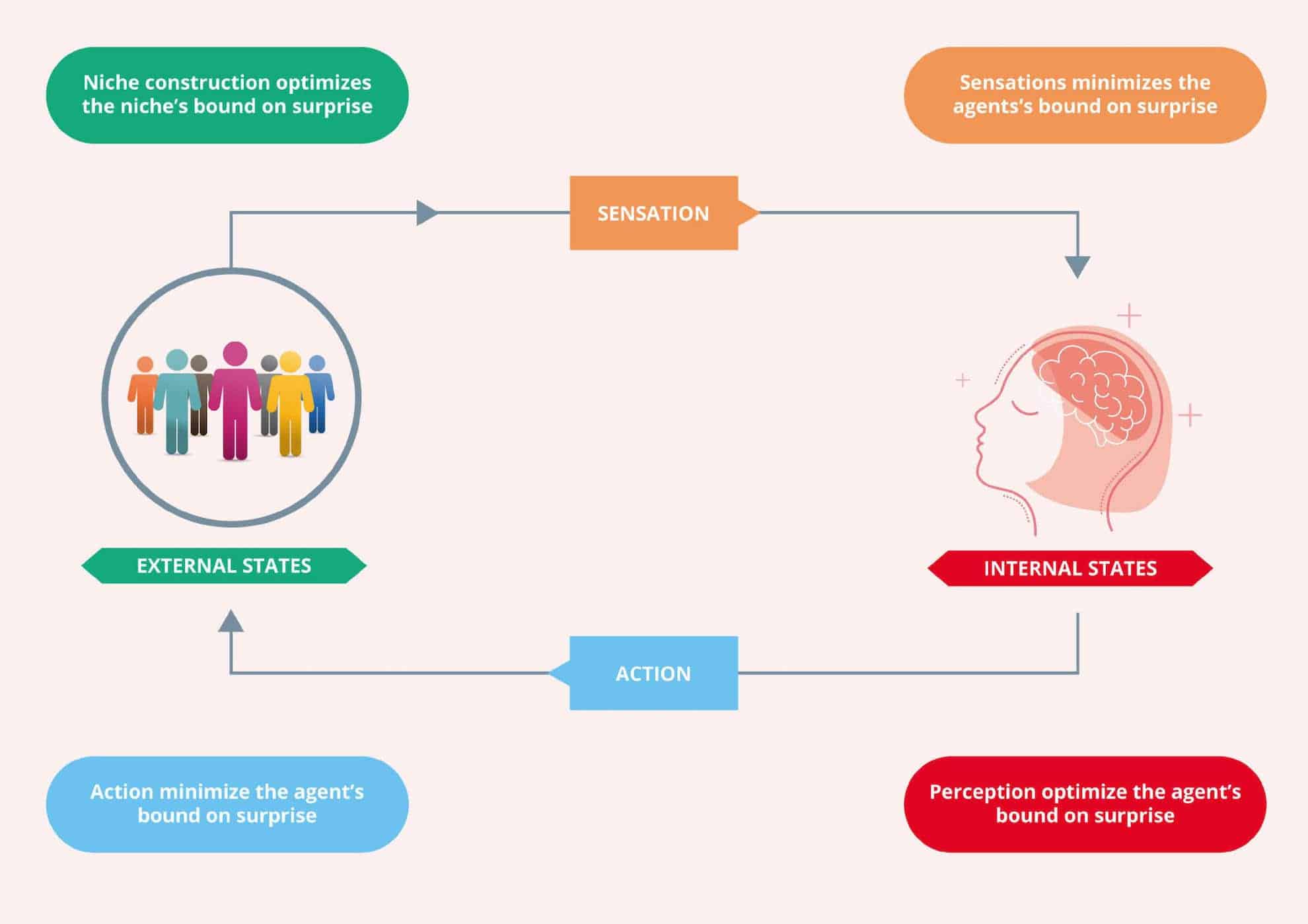
Osteopathy sees itself as a patient-centered, evidence-based approach that integrates various disciplines. From a holistic perspective, the interactions between structure and function form the basis for the body’s self-maintaining and self-regulating processes. The therapeutic relationship, which is partly based on touch, serves to restore and maintain well-being and health. Within the osteopathic profession, there is still a lack of an integrative meta-framework that takes into account contextual factors, language, education, and non-verbal communication in addition to the manual treatment component. In a recent article, Jorge Esteves and colleagues addressed the question of how a unified framework can be reconceptualized without changing osteopathic care per se. The basic ideas will be briefly highlighted in this post. The authors elaborate on two central concepts: enactivism and active inference. Here, enactivism refers to the subject’s process of perception from within its environment, from which intelligent action is derived, while inference refers to those statements through whose verification a logical conclusion is reached. Furthermore, active inference serves to logically reflect upon and adapt the consequences of one’s own actions. These two concepts can work together as (en)active inference to reveal the mechanisms within osteopathy that underlie interprofessional and intra-therapeutic exchange. The dyadic exchange between osteopaths and patients offers both parties a range of different possibilities for action. This allows individual adaptability to be restored and/or promoted. The therapeutic relationship thrives on the creation of a therapeutic space, meaningful imagery, and the re-evaluation of symptoms. In addition to these factors, manual touch contributes significantly to the development of the therapeutic relationship by establishing synchronicity between the osteopath and the patient. Especially in the care of infants and young children, touch plays a decisive role in the regulation of allostasis and homeostasis. The authors argue that active therapeutic inference favors the development of a robust therapeutic dyad and is therefore a decisive factor in the effectiveness of osteopathic treatment. The presented framework is intended to pave the way for the development and validation of an integrative model for osteopathic care. Clinical practice could thus evolve psychologically to strengthen its own self-perception mechanisms and interpretations. In particular, the treatment of persistent physical symptoms, such as chronic pain, could benefit from the inclusion of emotional and cognitive factors (Esteves et al. 2022). Literature: Esteves JE, Cerritelli F, Kim J, et al. Osteopathic Care as (En)active Inference: A Theoretical Framework for Developing an Integrative Hypothesis in Osteopathy. Front Psychol. 2022;13(February):1-19
Osteopathic treatment as (en)active inference
Osteopathy sees itself as a patient-centered, evidence-based approach that integrates various disciplines. From a holistic point of view, the interactions between structure and function form the basis for the self-maintaining and regulating processes in the body. The therapeutic relationship, which is partly based on touch, serves to restore and maintain well-being and health. There is still a lack of an integrative meta-framework within the osteopathic profession that takes into account contextual factors, language, education and non-verbal communication in addition to the manual treatment component. The question of how to reconceptualize a unified framework without changing osteopathic care per se has been addressed by Jorge Esteves and colleagues in a recent article. The basic ideas will be briefly highlighted in this article. The authors elaborate two central concepts, that of enactivism and active inference. Here, enactivism refers to the subject’s process of perception from its environment, through which intelligent action is derived, and inference refers to those statements through whose verification one arrives at a logical conclusion. Furthermore, active inference serves to logically reflect and adjust consequences of one’s own actions. The two concepts can work together as (en)active inference to reveal the mechanisms within osteopathy that underlie interprofessional as well as intratherapeutic exchange. The dyadic exchange between osteopaths and patients offers both a range of different possibilities for action. In this way, individual adaptability can be restored and/or promoted. The therapeutic relationship here thrives on the creation of a therapeutic space, meaningful images and the re-evaluation of symptoms of illness. In addition to these factors, manual touch contributes significantly to the development of the therapeutic relationship by creating synchronicity between osteopath and patient. Especially in the care of (young) children, touch plays the crucial role in regulating allostasis and homeostasis. The authors argue that active therapeutic inference fosters the development of a robust therapeutic dyad and is thus instrumental in the effectiveness of osteopathic treatment. The framework presented is intended to set the stage for the development and validation of an integrative model for osteopathic care. Clinical practice could thus evolve psychologically to strengthen its own self-perception mechanisms and interpretations. In particular, the treatment of persistent physical symptoms, such as chronic pain, could benefit from expansion with emotional and cognitive factors (Esteves et al. 2022). Literature: Esteves JE, Cerritelli F, Kim J, et al. Osteopathic Care as (En)active Inference: A Theoretical Framework for Developing an Integrative Hypothesis in Osteopathy. Front Psychol. 2022;13(February):1-19