BY TORSTEN LIEM & MAXIMILIAN MOSERSummaryRhythmicity is a universal organizational principle in nature. A central pacemaker could not be identified; however, a dominance of central oscillators was observed. The spectrum and characteristics of biological rhythms and time cues are presented, and the modes of action of endogenous and exogenous rhythms are discussed. The variable interplay of biological rhythms plays a significant role in healing and regenerative processes in the organism.KeywordsBiological rhythms, biological oscillations, exogenous time cues, endogenous and exogenous rhythms, oscillatory processes, pulse–respiration quotients, microvibration, EEG alpha waves, structure–function relationshipAbstractRhythm is an universal principle of natures’ organization. A central timer could not be established, but a dominance of central oscillation was found. The spectrum and characteristics of the biological rhythms and timers is described and the endogenetic and exogenetic rhythms are discussed. The dynamic interaction of the biological rhythms play an important role in initiation of healing and regenerative processes of the human body.KeywordsBiological rhythm, biological oscillation, exogenetic timer, endogenetic and exogenetic rhythm, oscillatory processes, pulse-respiratory quotient, microvibration, alpha wave (EEG), structure-functional relationshipIntroductionOur entire lives are shaped by biological rhythms, and our organism has not only a spatial but also a temporal structure. New findings highlight the great importance of biological rhythms for health and also offer implications for approaches within osteopathic treatment. These go far beyond the manual synchronization with—partly speculative—rhythmic phenomena in the organism previously practiced in osteopathy, and deepen the understanding of the unity of the organism, the human temporal structure, and its functional interactions. Rhythmicity is a universal organizational principle in nature. However, a central pacemaker could not be identified; rather, a dominance of central oscillators can be observed. Therefore, the focus is no longer on the question of a central pacemaker, but on the question of coordination dynamics between more environment-related and integrating rhythms.Rhythmicity – a Fundamental Property of LifeRhythmicity, regulation, and spatiotemporal coordination characterize fundamental properties of life, with the aim of generating order and preventing the degradation of energy. Rhythmicity is a universal organizational principle of genotypic and phenotypic expression and of metabolic regulation. As a self-organizing force of the organism, it encompasses all processes from the beginning of fertilization through growth, homeostasis, and adaptive functions to death.Rhythmicity, Structure, and Function The model of a rigid structure–function relationship is expanded by a dialectical structure–function relationship, which is organized by multiple oscillatory processes that interact with one another. One example is the intercellular oscillation process described by Jaeger and Goodwin, which is thought to be regulated by cell-autonomous and non-autonomous processes and is, among other things, capable of reproducing dynamics of periodic gene expression patterns in embryogenesis [1].Understanding and knowledge of the dynamically synergistic and rhythmically organized regulatory equilibrium processes in humans can increase diagnostic and therapeutic potential in osteopathic practice. To understand organic order in humans, an overview of rhythmic processes and the organization of regulation is presented below. Both the phylogenetic and ontogenetic development of structure and function can be regarded as a unified process of reciprocal interactions. Rhythmicity generates order. In doing so, every increase in spatial order is accompanied by an increase in functional order. This applies at the molecular, cellular, and macro-organismic levels as well as at the population level. For example, cognitive order is linked to the oscillatory dynamics, coordination, and self-adaptation of brain tissue. Temporal structures acting within the organism are formed by regulatory properties of certain macromolecules (enzymes). Diffusion processes can lead to the development of local or global oscillations, resulting in the formation of structure.The System of Biological RhythmsBiological rhythms, like any oscillation, presuppose a polarity within the organism, between whose poles the back-and-forth of the oscillation can take place. This basic polarity can be found, for example, in the autonomic nervous system in the form of the antagonists sympathetic and parasympathetic (hereafter briefly referred to as the vagus), which stand for readiness for performance and readiness for recovery, respectively. The daily rhythm, mentioned by Hufeland [2] as a basic unit of biological temporality, is indeed a major oscillation between the sympathetically dominated day and the vagally dominated night. Within this oscillation, virtually all physiological and even some anatomical parameters change with varying amplitudes. Examples of physiological parameters include heart rate, body temperature, all body hormones, parameters of the immune system, and those of digestion. Anatomically, for example, body height and joint circumference as well as joint mobility change. Every morning at around 6 a.m., we are at our tallest and joint swelling is most pronounced, which simultaneously leads to reduced joint mobility and an increase in any joint discomfort. In the evening at 8 p.m., we are then at our shortest. Contrary to intuition, this cyclical change in height is not, or not only, attributable to the load on our skeleton from our body weight over the course of the day. It can also be observed when test subjects are allowed, on a 2-hour cycle, to stand for 60 minutes and lie down for 60 minutes, and measurements are then taken over 24 hours.Healthy interaction among organ systems is characterized by good synchronization with exogenous time cues/environmental factors in the long-wave range and good frequency and phase coordination of endogenous rhythms in the short- and medium-wave range. Synchronization disorders can be a sign of disease. Conversely, lifestyles that run counter to the natural order in the relationship between internal rhythm biology and external time cues may constitute a predisposition to disease, whereas a rhythm-appropriate lifestyle provides the basis for health.The rhythmic functions of the medium- and long-wave ranges are kept relatively constant due to synchronizing influences, in contrast to short-wave ranges. Long-wave rhythmicities tend to occur as pendular oscillations. They represent complex processes that combine a multitude of individual functions into an orderly interaction. Short-wave rhythmicities usually manifest as impulsive forms of oscillation (relaxation oscillations).Tab. 1: Characteristics of biological rhythms. * The higher the frequencies in the ultradian (multi-hour) range, the more strongly the rhythm is generally capable of modulation. (After Hildebrandt et al. 1998)
| Long-wave rhythms | Medium-wave rhythms | Short-wave rhythms |
| Days to years | Minutes to hours | Milliseconds to seconds |
| Affect the entire organism | Affect entire organs | Affect cells and tissues |
| Metabolism (e.g., wake–sleep cycle) | Rhythmic transport and distribution system (respiration, circulation) | Information system (nervous system) |
| Pendular oscillation | Impulsive forms of oscillation (e.g., relaxation oscillations) | |
| Under load: frequency-stable, amplitude-variable | Under load: limited frequency and amplitude variability* | Under load: frequency-variable, amplitude-stable |
| High-molecular-weight proteins | Ions (Na+, K+, Cl−) |
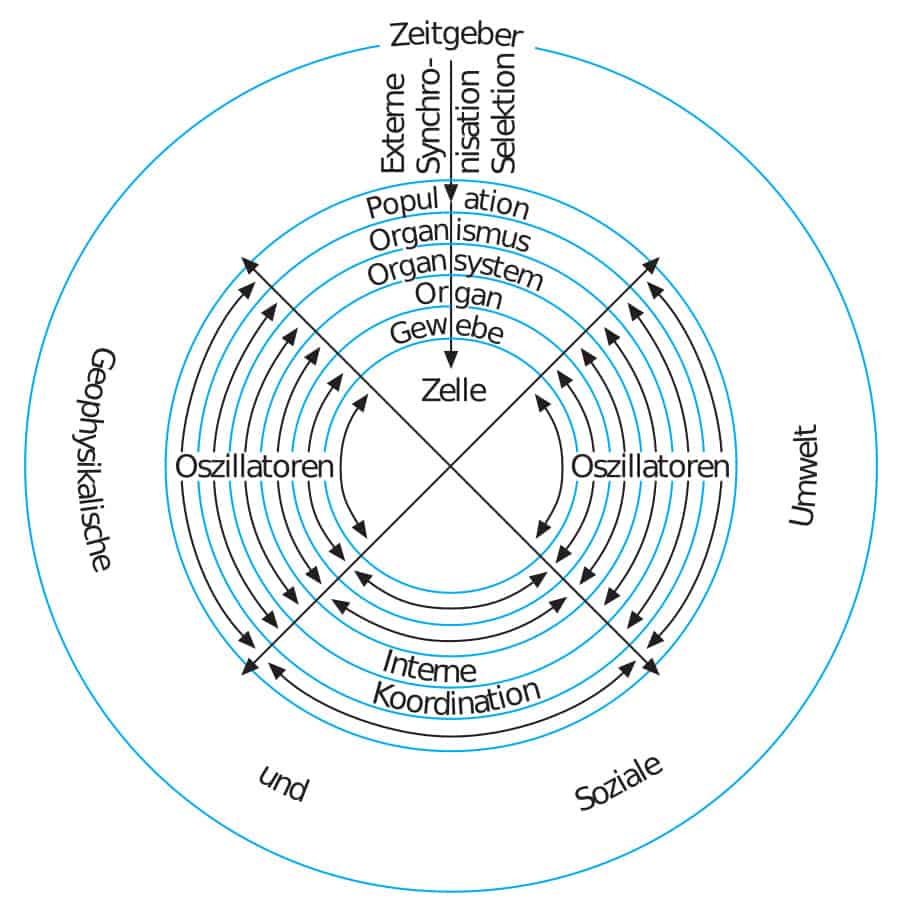
Time cues “Time cues” are physical or social stimuli that enable the human organism to align itself with external rhythms. Aschoff already recognized that the most important time cue is light, especially daylight [3]. Every morning from around 4 a.m., the human organism prepares for the start of the day and anticipates sunrise. When the sky light of the beginning day then appears, it triggers an entire cascade of physiological changes. For a long time, it was assumed that the eye’s photoreceptor cells—cones and rods—convey this stimulus to the rest of the organism. It was a minor sensation when, around the year 2000, new photoreceptor cells were discovered in addition to cones and rods. In fact, not only were new photoreceptor cells found, but also a new visual pigment: melanopsin was identified in the ganglion cells of the inner retina, a light-sensitive pigment previously demonstrated in primitive organisms, evolutionarily much older than the rhodopsins of cones and rods. These newly discovered “circadian photoreceptor cells” (described in older textbooks merely as ganglion cells without their own visual function) complement the previously known photoreceptors and, with their projecting nerve axons, do not lead like cones and rods to the visual cortex of the occipital cortex, but directly to the suprachiasmatic nucleus and onward to the pineal gland (epiphysis). Even before the discovery of circadian photoreceptor cells, it was known that destruction of the suprachiasmatic nucleus, for example by cancer, leads to severe circadian and sleep disturbances. The suprachiasmatic nucleus can therefore be seen as the coordinator of the daily cycle, with each cell in our body also having its own daily cycle controlled by its own genes. There is also new information from molecular biology in this regard: today it is assumed that there is practically no gene that is not under circadian control. Oscillation, therefore, is present throughout the organism, coordinated by time cues, by the suprachiasmatic nucleus, and by the interaction of the internal organs.In parallel with the discovery of circadian photoreceptor cells, it was recognized in other medical fields that explicitly circadian genes, such as PER2 and 3 or CLOCK, are of great importance for maintaining youthfulness as well as for protection against cancer. Epidemiological studies and meta-analyses showed that female night and shift workers have around 50% higher breast cancer rates, and male night and shift workers up to 400% higher prostate cancer rates. Studies in experimental animals showed that molecular-biological deletion of a single one (of eight currently known) of the genes controlling the daily rhythm (PER2) causes the affected animals to age and die dramatically faster than the comparison group of genetically identical rats with intact rhythm genes [4, 5]. By the end of the experiment, the animals still alive, unlike the genetically intact animals, already had cancer in 100% of cases. These new findings on the youth-preserving and cancer-protective effect of intact daily rhythms, published in a special issue of the renowned journal Cancer Causes Control [6], led in 2007 to a statement by the WHO (IARC, International Agency for Research on Cancer) in which night and shift work, when it disrupts biological rhythms, was classified as probably carcinogenic.Endogenous and Exogenous Rhythms For a long time, the seat of a central rhythm generator was assumed to be in neurohormonal central nervous structures, such as the pineal organ or the hypothalamus. However, this does not appear to exist. Nevertheless, a dominance of central oscillators can be identified. These are characterized by adapting the organism to environmental rhythms by synchronizing with them. For example, a modification of the light–dark periodicity leads to pronounced oscillations in the function of the pineal organ. A few days after the change in light–dark periodicity, however, independent oscillations of many functions as well as an unchanged adaptability of rhythms can also be recorded. From this, Sinz concludes a dynamic functional order mediated by mechanisms of non-linear coordination ([7], p. 75).This brings to the fore the question of coordination dynamics between more environment-related and integrating rhythms. This is not an active–passive relationship, but a coordination of self-excited cellular rhythms (synchronized at the tissue, organ, or organ-system level). Despite the differing significance of rhythms depending on the magnitude of frequency, this can also be derived from the interaction between organismic and environmental periodicities ([7], p. 114).Geophysical, ecological, and social environmental periodicities synchronize biological rhythms of cellular genesis. In addition, there is endogenous synchronization and coordination of multiple cellular, tissue, organ, organismic, and interorganismic oscillators. Between these systems there is a tendency toward frequency synchronization (Figs. 1 and 2).
Fig. 1: Time cues. [16]
Fig. 2: Spectrum of biological and geophysical rhythms. [16]
An external synchronization tendency in the 10 Hz range has been identified repeatedly. In this range, there is a clustering of biological oscillations (microvibration, EEG α-waves, pupillary unrest, ciliated epithelium cilia and ocular tremor movements, action potentials) and geophysical periodicities (seismic unrest, variation of the Earth’s magnetic field, infralong waves). Striking are also clear analogies in the temporal and amplitude behavior of minute-period pulsations of the Earth’s magnetic field and the circa-minute rhythms of organisms. However, no causal relationship has yet been established.Temporal fluctuations in the environment are thought to be registered simultaneously via different sensory structures in the organism. Anochin assumes that, in the emergence of life, temporal sequences of the external world as macro-time are reflected in the structures and organization of organisms as micro-time in the form of rapid chemical processes [8]. These internal temporal structuring patterns enable the organism—by generating probabilistic forecasts about the external world—to engage in goal-directed behavior. In humans, the psyche seems to be able, by means of biotic clocks or oscillatory processes, to produce probabilistic forecasts of the needs of one’s own inner world and the conditions of the external world, thus enabling successful regulation of the organism’s energy requirements [9]. These could, “as anticipatory reflection,” allow hypotheses about the world and serve to control behavior.Interplay of Body Rhythms An essential systemic property of biological rhythms is their reciprocal interplay, which can be observed particularly during rest phases. Over the course of 24 hours, it can be observed in a group of test subjects that the ratio of pulse rate to respiration, for example, takes on a value between 2:1 and 7:1.Test subjects with high pulse–respiration quotients lower this at night, while those with low pulse–respiration quotients raise it at night. Sleep therefore has a remarkable normalizing effect, tending toward a pulse–respiration quotient of 4:1. In the morning, the groups separate again, and each test subject returns to where they were the day before. Over the course of day and night, we therefore oscillate between an individual and a universal ratio of heartbeat to respiration [10].Further investigations have shown that healing and regenerative processes, such as spa treatments or rehabilitation, systematically strengthen this normalization tendency and establish a particularly economical mode of functioning of the organism. Such effects are also to be expected in osteopathic treatment, and they could also be used systematically to document success.From the research of Hildebrandt and colleagues, we know that phases of quiet sleep not only strengthen correlations between heartbeat and respiration, but also include additional rhythms in the coordination. Thus, the frequencies of blood pressure and peripheral perfusion rhythmicity coordinate with those of pulse rate and respiration. In each case, a ratio of 4:1—musically a double octave—is sought between successive rhythms [11]. While our organs therefore make music in a disorderly way during the day, at night they sing in chorus. This nighttime unison is, in all likelihood, crucial for well-being and health. Disruptions due to night and shift work lead to serious health problems—from metabolic disorders [12] and heart disease [13, 14] to a considerable increase in cancer incidence [6, 15]. A therapeutic goal of any nature-oriented treatment should therefore also be to restore rhythms and coordination, which can also be documented with today’s measurement methods.
Literature
[1] Jaeger J, Goodwin BC. Cellular oscillators in animal segmentation. Silico Biol 2002;2(2):111–123[2] Hufeland CW. Makrobiotik – oder Die Kunst, das menschliche Leben zu verlängern. A. F.Macklot, Stuttgart 1799[3] Aschoff J. Circadian Rhythms in Man. Science 1965;148(3676):1427–1432[4] Lee CC. Tumor suppression by the mammalian Period genes. Cancer Causes Control 2006;17(4):525–530[5] Fu L, Lee CC. The circadian clock: pacemaker and tumour suppressor. Nat Rev Cancer 2003;3(5):350–361[6] Moser M, Schaumberger K, Schernhammer E, Stevens RG. Cancer and rhythm. Cancer Causes Control 2006;17(4):483–487[7] Sinz R. Zeitstrukturen und organismische Regulation. Akademie Verlag, Berlin 1978[8] Anochin PK. Beiträge zur allgemeinen Theorie des funktionellen Systems. Fischer, Jena 1978[9] Jantzen W. Transempirische Räume – Sinn und Bedeutung in Lebenszusammenhängen. http://members.aol.comfba¬saglialmuhlh97.html ((The link does not work. Where was this published? In: Fischbeck H-J (ed.) Leben in Gefahr? Von der Erkenntnis des Lebens zu einer neuen Ethik des Lebendigen. Neukirchener Verlag, Neukirchen Vluyn 1999, pp. 123–144?))[10] Hildebrandt G, Moser M, Lehofer M. Chronobiologie und Chronomedizin. Weiz: Gesundheitsleitsystem; 1998, 2013[11] Raschke F. Chronobiological viewpoints of respiratory regulation. Wien Med Wochenschr 1995;145(17-18):435–439[12] Holmback U, Forslund A, Lowden A, Forslund J, Akerstedt T, Lennernas M, Hambraeus L, Stridsberg M. Endocrine responses to nocturnal eating – possible implications for night work. Eur J Nutr 2003;42(2):75–83[13] Knutsson A. Health disorders of shift workers. Occup Med (Lond) 2003;53(2):103–108[14] Karlsson BH, Knutsson AK, Lindahl BO, Alfredsson LS. Metabolic disturbances in male workers with rotating three-shift work. Results of the WOLF study. Int Arch Occup Environ Health 2003;76(6):424–430[15] Moser M, Fruehwirth M, Kenner T. The symphony of life – importance, interaction and visualization of biological rhythms. IEEE Eng Med Biol Mag 2008;27(1):29–37[16] Liem T. Van den Heede P. Foundations of Morphodynamics in Osteopathy: An Integrative Approach to Cranium, Nervous System, and Emotions, 2017; 1st ed. Handspring Publishing Limited, Pencaitland.