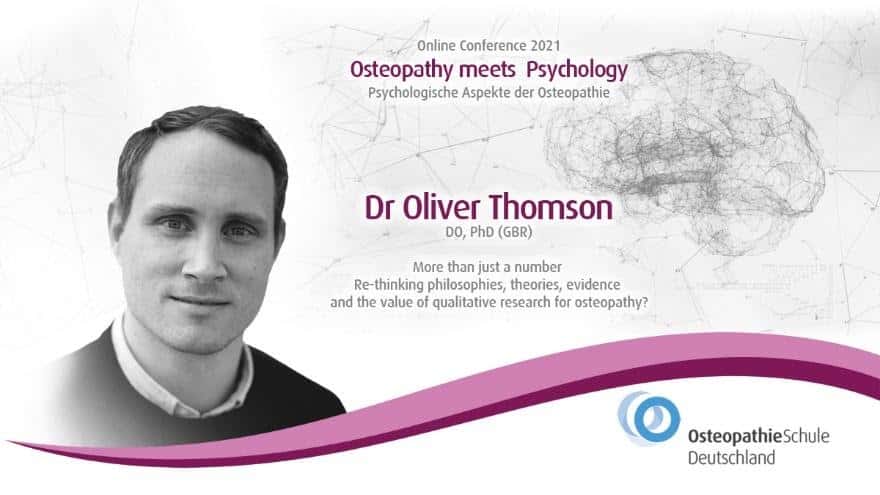
The osteopath Dr. Oliver Thomson is Associate Professor at the University College of Osteopathy and works as a researcher focusing on qualitative methods. “The act of caring for another person’s health is in itself a psychological, social and human act. For that reason, the practice of osteopathy cannot escape a psychological stance.” On November 19th, you can see Dr. Oliver Thomson with a lecture at the ONLINE CONFERENCE 2021 of the Osteopathie Schule Deutschland: “More than just a number – Re-thinking philosophies, theories, evidence and the value of qualitative research for osteopathy”Register:https://web.cvent.com/event/e52b2684-e9a5-4ef1-9e61-f3eb9bc1f042/summaryInterview with Dr. Oliver Thomson by Torsten Liem:WHAT POTENTIAL DO YOU SEE IN PSYCHOLOGY FOR OSTEOPATHY?I don’t see the distinction between osteopathy and psychology. Osteopathy involves the care of people by people. The act of caring for another person’s health is in itself a psychological, social and human act. For that reason, the practice of osteopathy cannot escape a psychological stance. Whether or not the practitioner is aware of this stance is another matter. Of course, osteopathy (and osteopaths) can become more informed and aware of psychological theories and evidence to further develop and enhance their care of people.WHAT WAS AND IS YOUR MOTIVATION FOR BUILDING UP YOUR WORDS MATTER PODCAST?It started when the pandemic struck and my clinical practice had to shut down. I wanted to keep being productive, so I started the podcast originally focusing on communication and back pain. It has since developed to explore a range of topics related to healthcare, from philosophy and qualitative research to the nature of clinical practice. I really enjoy the long-form conversations with smart people… we dive into rabbit holes and sometimes never find our way out. The conversations hopefully show that there are rarely clear-cut answers to things and that context and nuance are crucial… things which are often missed by current social media headlines and soundbites.WHAT COULD BE SOME CLINICALLY RELEVANT OUTCOMES FOR OSTEOPATHY FROM YOUR RESEARCH?I am currently involved in several research projects, including a national mixed-methods study on osteopaths’ utilization of the biopsychosocial model in New Zealand. Another study is looking at the skills and attitudes of osteopaths in relation to evidence-based practice, where we are currently running surveys in Italy and Canada. A really exciting international project that I’m leading is one whereby we are developing and testing a questionnaire tool which looks to gather data about osteopaths’ therapeutic approaches. The Osteopaths Therapeutic Approaches Questionnaire (Osteo-TAQ) is based on a grounded theory I developed for my PhD research, and looks to give much more detail about how osteopaths think, relate and interact with their patients. We are continuing the study in Australia and the UK, and hope to work with international colleagues to test and translate the tool to be used in different countries and cultural contexts. More information is here: https://www.uco.ac.uk/research/osteo-taq-0. It is hoped that the Osteo-TAQ, when combined with patient-reported outcomes and other measurements, may give us a better idea of how the vast array of osteopathic approaches influence clinical outcomes. With all these projects, I hope that the new knowledge which is generated supports osteopathy and osteopaths to critically reflect on their thinking and practice, to provide more person-focused and evidence-informed ways of caring for people. AT THE ONLINE CONFERENCE OF OSTEOPATHIE SCHULE DEUTSCHLAND YOU WILL TALK ABOUT “MORE THAN JUST A NUMBER – RE-THINKING PHILOSOPHIES, THEORIES, EVIDENCE AND THE VALUE OF QUALITATIVE RESEARCH FOR OSTEOPATHY”. WHAT CAN THE PARTICIPANTS EXPECT TO LEARN FROM YOUR LECTURE? My experience of talking with philosophers and academic-clinicians about using theory and philosophy in our practice and research. Osteopathy claims to have a strong theoretical and philosophical basis; however, much of these ideas were developed at a time when dualism and biomedicalism were dominant. I hope that participants get a sense of how theories from outside of osteopathy can help shape our practice and enrich our research.MORE INFORMATION ABOUT THE ONLINE CONFERENCE 2021 YOU CAN FIND: https://www.osteopathie-schule.de/online-conference-2021/
English Version
DO YOU KNOW DR. OLIVER THOMSON?The osteopath Dr. Oliver Thomson is Associate Professor at the University College of Osteopathy and works as a researcher focusing on qualitative methods. “The act of caring for another person’s health is in itself a psychological, social and human act. For that reason the practice of osteopathy cannot escape a psychological stance, whether or not the practitioner is aware of this stance is another matter.” On November 19th, Dr. Oliver Thomson will give a lecture at the ONLINE CONFERENCE 2021 of the Osteopathie Schule Deutschland: “More than just a number – Re-thinking philosophies, theories, evidence and the value of qualitative research for osteopathy” https://web.cvent.com/event/e52b2684-e9a5-4ef1-9e61-f3eb9bc1f042/summaryInterview with Dr. Oliver Thomson by Torsten Liem WHAT POTENTIAL DO YOU SEE IN PSYCHOLOGY FOR OSTEOPATHY?I don’t see the distinction between osteopathy and psychology. Osteopathy involves the care of people by people. The act of caring for another person’s health is in itself a psychological, social and human act. For that reason the practice of osteopathy cannot escape a psychological stance, whether or not the practitioner is aware of this stance is another matter. Of course, osteopathy (and osteopaths) can become more informed and aware of psychological theories and evidence to further develop and enhance their care of people.WHAT WAS AND IS YOUR MOTIVATION FOR BUILDING UP YOUR WORDS MATTER PODCAST?It started when the pandemic struck and my clinical practice had to shut down. I wanted to keep being productive, so I started the podcast originally focusing on communication and back pain but it has since developed to explore a range of topics related to healthcare from philosophy, qualitative research, and the nature of clinical practice. I really enjoy the long-form conversations with smart people…diving into rabbit holes and sometimes never finding our way out. The conversations hopefully show that there are rarely clear-cut answers to things and that context and nuance are crucial…things which are often missed by current social media headlines and soundbites.WHAT COULD BE SOME CLINICALLY RELEVANT OUTCOMES FOR OSTEOPATHS FROM YOUR RESEARCH?I am currently involved in several research projects including a national mixed-methods study on osteopaths’ utilization of the biopsychosocial model in New Zealand. Another study is looking at the skills and attitudes of osteopaths in relation to evidence-based practice, where we are currently running surveys in Italy and Canada. A really exciting international project is one that I’m leading whereby we are developing and testing a questionnaire tool which looks to gather data about osteopaths’ therapeutic approaches. The Osteopaths Therapeutic Approaches Questionnaire (Osteo-TAQ) is based on a grounded theory I developed for my PhD research, and looks to give much more detail about how osteopaths think, relate and interact with their patients. We are continuing the study in Australia and the UK, and hope to work with international colleagues to test and translate the tool to be used in different countries and cultural contexts. More information is here https://www.uco.ac.uk/research/osteo-taq-0. It is hoped that the Osteo-TAQ, when combined with patient-reported outcomes and other measurements, may give us a better idea of how the vast array of osteopathic approaches influence clinical outcomes. With all these projects, I hope that the new knowledge which is generated supports osteopathy and osteopaths to critically reflect on their thinking and practice, to provide more person-focused and evidence-informed ways of caring for people. AT THE ONLINE CONFERENCE OF OSTEOPATHIE SCHULE DEUTSCHLAND YOU WILL TALK ABOUT “MORE THAN JUST A NUMBER – RE-THINKING PHILOSOPHIES, THEORIES, EVIDENCE AND THE VALUE OF QUALITATIVE RESEARCH FOR OSTEOPATHY”. WHAT CAN THE PARTICIPANTS EXPECT TO LEARN FROM YOUR LECTURE? My experience of talking with philosophers and academic-clinicians about using theory and philosophy in our practice and research. Osteopathy claims to have a strong theoretical and philosophical basis; however much of these ideas were developed at a time when dualism and biomedicalism were dominant. I hope that participants get a sense of how theories from outside of osteopathy can help shape our practice and enrich our research.MORE INFORMATION ABOUT THE ONLINE CONFERENCE 2021 YOU CAN FIND: https://www.osteopathie-schule.de/online-conference-2021/