Interview with Torsten Liem
Movement in Thinking, Feeling, and Acting
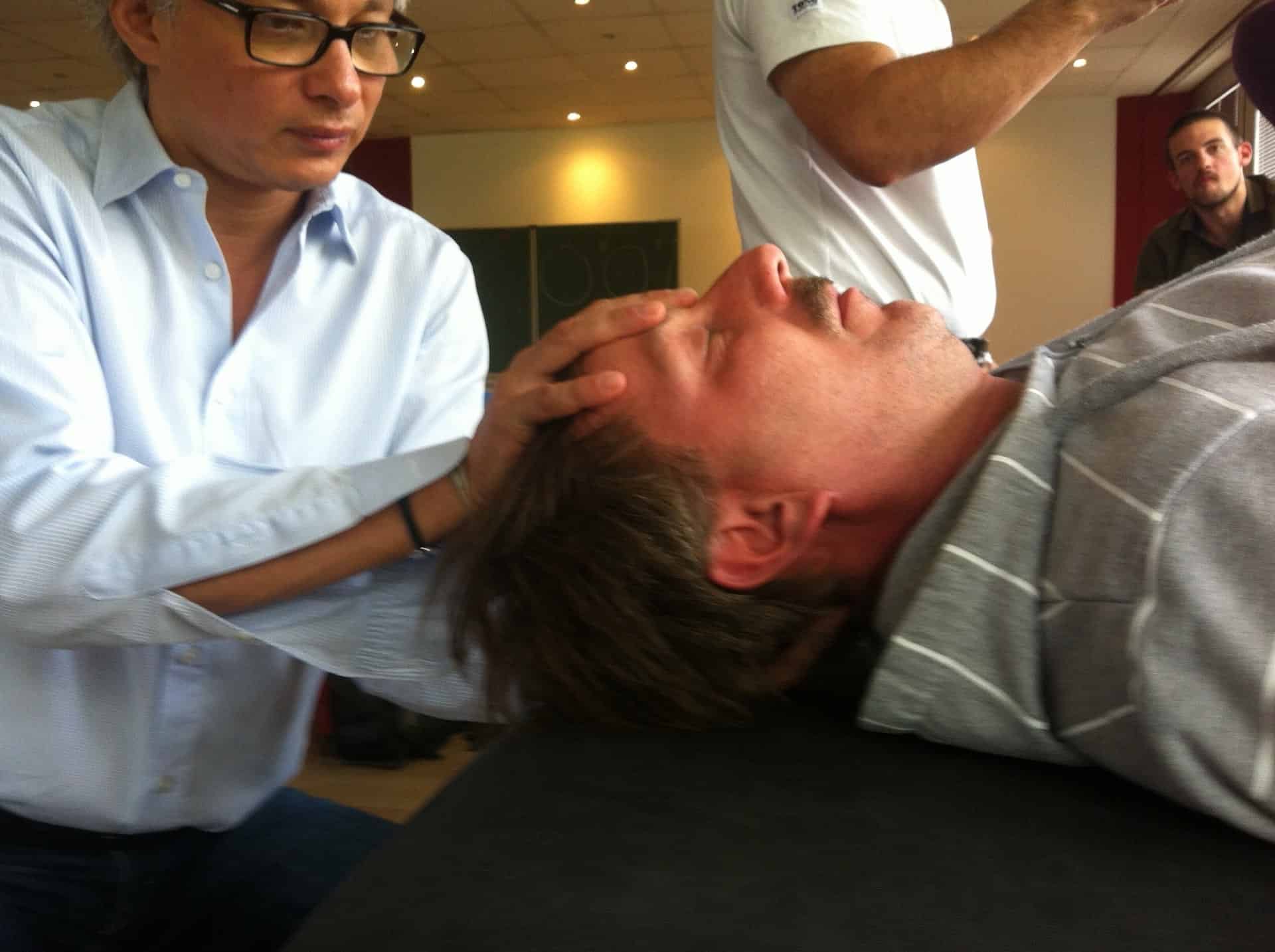
In his newly published book “The Osteopathy Self-Help Book,” osteopath Torsten Liem recommends self-help exercises for a long, healthy, and happy life. Andrea Freund spoke with the director of the Osteopathy School Germany for NATUR & HEILEN about his therapeutic approach. Many people think of osteopathy as a manual therapy that they experience passively. You want to go beyond these boundaries. How did this come about? It was a minor weakness of osteopathy that for a long time it was only about treatment by the osteopath. This stems from the emergence of this healing method during the Industrial Revolution. Therefore, the founder Andrew Taylor Still compared the human being to a machine and the osteopath to a precision mechanic who adjusts disturbed parts—and then this human machine heals itself, so to speak. However, times have changed. The holistic view that the human being is a unity interwoven to the innermost and outermost and at the same time is characterized by a dynamic and hierarchically mutually influencing complexity can today be recognized and treated in a much more differentiated manner than was scientifically possible at the beginning of osteopathy. Today we know that a whole range of factors influences health and well-being and that a whole range of sciences is needed to understand these factors: epigenetics, genetics, biochemistry, psychology, social sciences, to name just a few. Today, for example, it is known that tissue dysfunctions are reflected in multiple ways in patterns of experience and consciousness and in all our life expressions. And from these insights you developed what is known as Psychosomatic Osteopathy, which involves the patient more actively?Yes. In osteopathy, the organism was viewed as a whole from the very beginning; later, the patient’s life context was included. Psychosomatic Osteopathy, which I developed, not only views body, mind, and soul as a unity, but examines and treats in a differentiated manner the dynamics between body, psyche, and the living environment as well as other connections. At the same time, the patient’s awareness, attitude, behavior, and individual potential to actively participate in their recovery are given a central role in the healing process. As a result, the patient takes a more active role in treatment than is usual in osteopathy. How do patients benefit from being more actively involved?In patients who are more proactive and take more responsibility for themselves, healing demonstrably proceeds not only faster but also more sustainably. Therefore, my goal is to promote this attitude. One of the most important principles in osteopathy is “Life is movement.” After many years of extensive practical experience, I know: My treatment is only worth half if the patient does not “move” themselves, that is, does not actively participate. You relate being flexible not only to the body but also to thinking and feeling. What do you mean by that? Proactivity is another word for flexibility, namely in thinking, feeling, and acting. This means, if my job is not good for me, not to persist there, but to increase my resilience so that I can compensate for it. And in the worst case, perhaps also to change jobs. Or if I notice that certain relationships are not good for me, to actively address this or possibly also to separate from these people—even if it is initially difficult for me. The desire must arise in the patient to set out on the path and change their life so that they feel better in the long term. For this, thoughts must first be set in motion. I relax a body region and thereby they can have a new, conscious experience. This is what it feels like to be relaxed; the mind becomes freer. The question now is: What supports the patient’s relaxation in their life and what can they do for it? Do you have a concrete example?I release, for example, the tight solar plexus. In doing so, I ask them how they perceive this, what changes, how they feel. “It feels softer,” they might say. And is anything else happening? “Yes, my thoughts are suddenly calmer. I feel so expansive and soft!” Then I can perhaps give them a small homework assignment to observe until the next time which circumstances in their life make their solar plexus softer, and to write these down. Of course, many things are easier in the protected practice space. Then it is part of the treatment to support them in becoming increasingly competent themselves. Ultimately, however, the patient decides whether they want to live in an increasingly relaxed manner, with a more open body posture—or not.Is your book aimed at healthy people or also at those with complaints?At both! Health insurance companies have determined that men have complaints for 48 years of their lives and women for 42 years. Often more than half a lifetime! This phase can be significantly improved if one changes their lifestyle.In my book, I explain mechanisms of action clearly for each body system, organs, and many clinical conditions. This gives the patient, the reader, a foundation to make the right decisions for themselves and to do something themselves. This involves the 5 models of osteopathy, plus the latest medical findings from more than 8,000 studies. These studies tell us how we can live longer, healthier, and happier today. Therefore, the book contains many exercises and suggestions, for example on endurance, interval training, stretching, breathing, relaxation, nutrition, a healthy gut, and how to change unfavorable habits. If there are unhealthy lifestyle habits, I also try as a therapist to establish healthier ones instead, so that the chance of being healthy and happy increases—as in manual treatment. We also call this Connecting the Dots.Is there a particularly effective exercise from your book?For me, there is no such thing, the one super-advice. Nevertheless: For most people who come to me, the most important thing is to regularly interrupt their sitting. Sitting weakens the immune system; it leads to exhaustion and illness. After just 30 to 45 minutes, the muscle no longer absorbs sugar and begins to break down. Therefore: Always interrupt sitting, run up and down stairs, do jumping jacks or push-ups … I do this too when I work at my desk for longer periods. It is scientifically proven and brings incredible benefits.Torsten Liem, thank you very much for this conversation!Andrea FreundAndrea Freund is an author and editor, trained as a non-medical practitioner for psychotherapy (CBT), in Spiritual Astrology, and as a yoga teacher.Interview published in the magazine NATUR & HEILEN, Issue 12/2022,https://www.naturundheilen.de/wissensschatz/artikel/moderne-osteopathie/