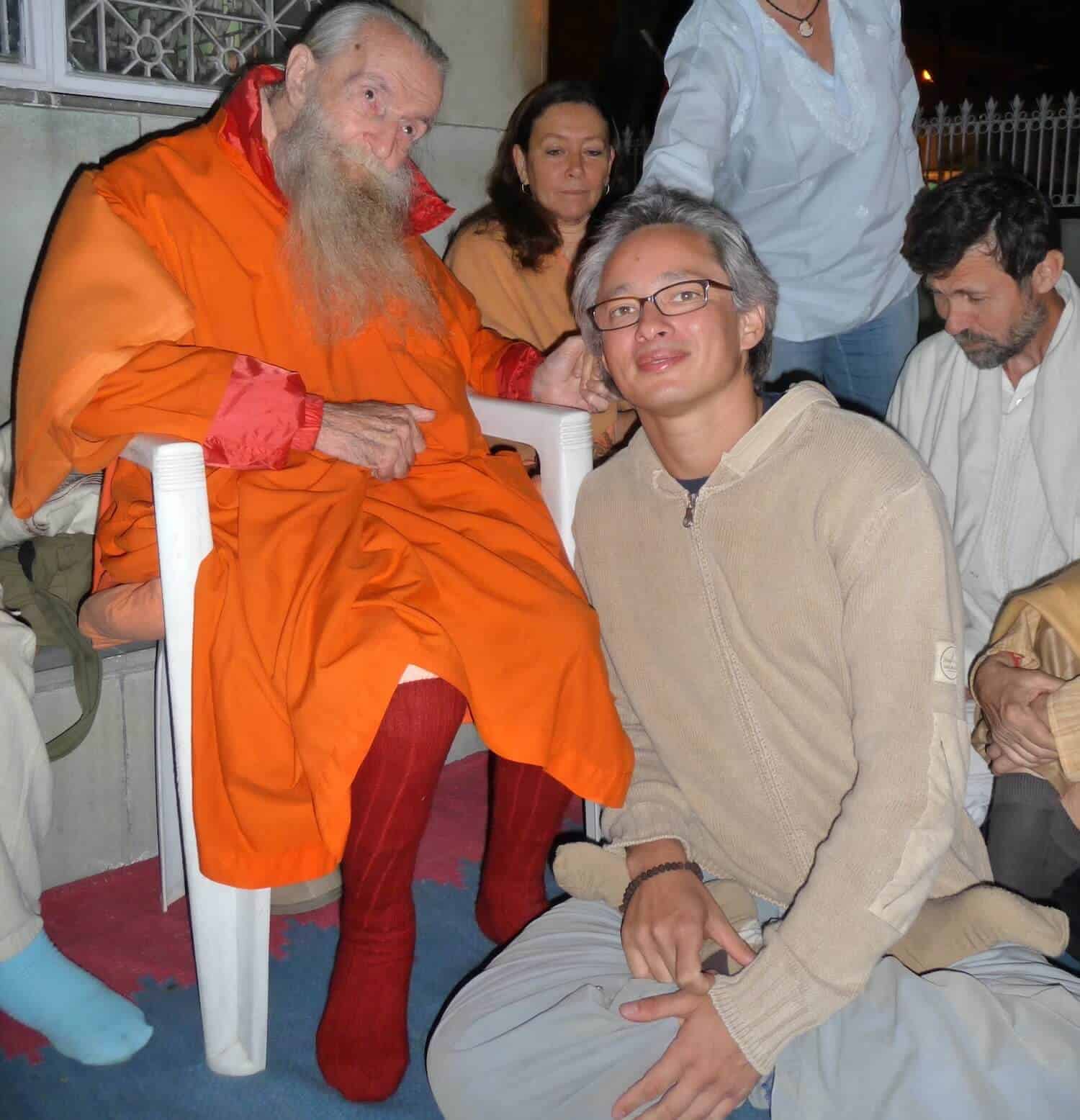
The interview took place on February 14, 2010, shortly before his death. At the end of 1950, he traveled by boat from Marseille to Sri Lanka and India to find his master. His idea was to ask him for advice and then return to southern France, where he worked as a physician. Ultimately, he remained in India for the rest of his life—the following 59 years, of which he spent over 10 years in complete solitude in the Himalayas. Brief BiographySwami Vijayananda (November 26, 1914–April 5, 2010)On November 26, 1914, at the beginning of World War I in eastern France, Vijayananda was born into a Jewish family and was expected to succeed his father, the Chief Rabbi of Metz. As a child he was very devout, but in his youth, he studied philosophy and began to distance himself from monotheistic religious dogmas. Later he studied medicine and initially followed a spiritual teacher in Paris, a French psychiatrist influenced by Buddhism. At the end of 1950, he traveled by boat from Marseille to Sri Lanka and India to find his master. His idea was to ask him for advice and then return to southern France, where he worked as a physician. He had hoped to meet Shri Ramana Maharshi and Shri Aurobindo, but when he arrived in Chennai in January 1951, both had just died. Instead, he met Ma Anandamayi on February 2, 1951, in Varanasi and asked her if he could stay at her retreat for two or three days, which ultimately became 59 years. A long period totaling over 10 years he spent in complete solitude in an ashram in the Himalayas, as Ma Anandamayi, his spiritual teacher, sent him there. In 1985, after the death of Ma Anandamayi, she asked him to care for visitors to the ashram, which he did until the end of his life.
- You were a physician in France and have now lived in India for almost 60 years. Why did you never return to France?
I have lived in India for 58 years; I came here to find the true teacher. I found Ma Anandamayi. If I have found what I was looking for, why should I go back? I found exactly what I was looking for, as if by a miracle. So there is no reason to go back. As if by a miracle, I found what I was looking for.
- You lived alone in the Himalayas for several years.
Yes, for many years. Ma Anandamayi sent me there. It was a new ashram and no one wanted to stay there. Ma told me, Vijayananda, you will go there. She wanted me to go there. There was no water. I had to walk 1.5 miles to get drinking water. There was no food, no light, no electricity. I had to walk in the jungle at night with a kind of torch.
- Is your state of peace a constant state?
Peace is almost constant. When you are alone in the jungle, there are many reasons to be afraid of many things. So my goal was to have no more fear, completely no more fear, to be completely fearless—all the time.
- Your state of peace, is it the same as bliss—Ananda?
No, bliss is a much higher state. From time to time I experience bliss. Peace is a basic feeling.
- What can bring us peace of mind when we live in the world?
When you are in meditation and you experience the consciousness of unity and when you feel that you are divine consciousness and cannot die, are immortal.
- What can we do to reduce our destructive emotions, such as hatred, desire, sorrow?
Fear, anger, sexual desire. Meditation, looking inward, becoming aware of how the mind works. When you notice/understand how the mind works, you can control these.
- What is the difference between meditation with a mantra or observing the breath?
Observing the breath is not the real pranayama. The real pranayama is controlling the nadi. Observing the breath is not the real thing. Only an aid.
- And a mantra?
A mantra can be used as support for the mind.
- What is the difference between a spiritual and a worldly life?
Pleasure, frustration, going inward, away from pleasure. The “Self” is the source. The inner Self is the true cause of joy. People go everywhere in the world to find happiness and joy. If you find it within yourself, you do not need to seek it outside. What you seek outside, in the world, you find inside. What you seek outside in the world, you find within yourself, inner peace. When you recognize that everything is within you, then you do not need to seek it outside, to run outward.
- What is the problem with seeking it outside?
When you feel it inside, then you recognize that joy is not dependent on something external. When you are oriented outward, have a girlfriend or boyfriend, and are dependent on them… Your inner joy is not dependent on anything, it is within you. The essence is within you.
- Is it essential for a spiritual life to withdraw from the world?
No, there are many paths, e.g., Karma Yoga. Through this you also change the attitude of the mind. You remain where you live and you change the attitude of the mind. Explanation by Torsten Liem: Karma Yoga is characterized by selfless service and action.
- If you live together with a partner in a family. What is the path of a spiritual life?
You see the woman as a divine mother, as a feminine God, and tell yourself that you are serving God. And you show respect to the feminine mother. That is the path for you as a man.
- Is there a relationship between spirituality and health?
You need a strong and healthy body if you want to meditate well. If you are weak, you cannot realize a good spiritual life. If you eat healthy food, you are strong and detoxify yourself, cleanse internally. Do not eat too much, otherwise you will become ill. But enough to have a healthy and strong body.