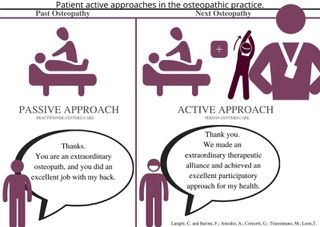
Lunghi, C.; Baroni, F.; Amodio, A.; Consorti, G.; Tramontano, M.; Liem, T. Patient Active Approaches in Osteopathic Practice: A Scoping Review. Healthcare 2022, 10, 524. https://doi.org/10.3390/healthcare10030524https://www.mdpi.com/2227-9032/10/3/524Osteopathy, as a form of manual therapy, can be defined as a holistic, patient-centred healing method that uses touch to promote health-maintaining processes in the human body. The focus is on the so-called somatic dysfunction (SD), which presents itself in different regions of the body (Tramontano et al. 2020, 2020, 2021). In addition to physical treatment, osteopathic education also includes other health promotion topics, including physical activity, lifestyle and nutrition (Van Dun et al. 2016, Mistry et al. 2018). Changes in these areas support patients’ full recovery by improving individual coping strategies. Active osteopathic techniques as well as dynamic movement tasks can thus support the management of the presenting SD and modulate individual energy levels (Lederman 2005. Lunghi et al. 2016). In addition to passive techniques, osteopathic treatment also integrates active therapeutic methods (so-called patient-active osteopathic approaches (PAOAs)). Previous research on osteopathic manipulative therapy (OMT) often emphasised passive techniques, which is why there are few evidence-based statements on how PAOAs work. Lunghi and colleagues addressed this research gap in a scoping review by assessing the existing literature in relation to the functioning and principles of PAOAs. A description of the methodology used, the findings and practical recommendations for integration into patient management strategies can be found in this article.Methodology:For the systematic development of the scoping review, the researchers first formulated the research question in order to conceptually delineate the topic area of PAOAs from the passive literature. The research question addresses the functioning and principles of PAOAs and their integration into patient management strategies. A systematic literature search was then conducted and the results of the relevant studies were presented.Using the “Preferred Reporting Items for Systematic Reviews and Extensionof Meta-Analyses for Scoping Reviews” (PRISMA) checklist, the studies were checked for their relevance. The systematic nature of the search is reflected in the definition of the search terms and the operators used, which ensures the reproducibility of the search strategy. An illustration of the search strategy of the literature search conducted can be found in the table below:In addition to physical treatment, osteopathic education also includes other health promotion topics, including physical activity, lifestyle and nutrition (Van Dun et al. 2016, Mistry et al. 2018). Changes in these areas support patients’ full recovery by improving individual coping strategies. Active osteopathic techniques Approaches to patient-active osteopathy
- Fascia-oriented active approach
A sedentary lifestyle affects the elasticity of connective tissue by contributing to a multidirectional orientation of fibrils and thus high transverse strength. At the same time, the ability to form physical and electrical connections is reduced. These processes are reversed through physical activity. The fascia-oriented active approach according to Schleip and Müller includes fascia remodelling (=reaction of the network of collagen fibres to mechanical stimuli), fascia recoil (=elastic tissue return through active exercises), dynamic stretching (long-term exercises that increase fascia elasticity) and fascia awareness (to sharpen body awareness) as central principles. Above all, fascia remodelling as well as connective tissue structure in general can be positively influenced by active fascia training performed regularly 1–2 times/week (Schleip and Müller 2013).
- Integrated mental imagery and exercises
Interoceptive body awareness, including the perception of the position of body parts in space, is generated by the musculoskeletal system. This knowledge should be conveyed to patients and integrated into practical, experiential bodywork (Calsius et al. 2016).Mental imagery or imagination as a training method has been shown to have a positive effect on motor and cognitive performance, activating the brain in a similar way that physical movement does.This methodology, in combination with manual treatment as well as active exercises, is able to improve pain control, motor skills, and the stimulation of motor neurons and non-motor performance aspects. Furthermore, it can strengthen self-confidence and reduce anxiety (Abraham et al. 2020).Osteopathy already works with mental imagery (Dorko 2003, Minasny 2009), e.g. in fascia rolling. Here, the connective tissue is slowly stroked out while an imagination exercise is carried out at the same time, with the aim of improving interoception. Particular attention is paid to training perception of a myofascial tension to be released or a motor movement to be performed. The technique is performed as follows: The osteopath provides slight resistance to the movement, which is perceived by the patients through active and gentle “manual transmission”. In support, the therapists can place their hands on the affected region (Dorko 2003). This so-called work-in method, in combination with mental imagery or on its own, can promote the state of relaxation mediated by the parasympathetic nervous system (Wallden 2012).
- Mindfulness-based physical activity
As described above, osteopathy works with interoception, which requires a certain degree of mindfulness (of one’s own body). For successful treatment, therapists and patients alike need to act mindfully. The term mindfulness here refers to gently directing attention to present experiential perceptions, such as thoughts, emotions and sensations, without evaluating them (Liem et Lunghi 2021). In osteopathic practice, simultaneous to mindfulness-based practice, “oscillations, vibrations and spontaneous myofascial and neurogenic shocks are used to reduce stress and restore homeostasis to the body” (Comeaux 2005, Liem et Lunghi 2021).
- Gamification and problem solving in an interactive dyadic approach
The body perception systems provide the brain with information that it uses to form a picture of the external and internal environment and to plan and carry out subsequent activities. The development of diseases is partly caused by errors in the processing and integration of multisensory body signals, which leads to pathophysiological regulation processes.Gamification refers to the application of game-typical elements in a non-game context. This can create a team-oriented, patient problem-solving atmosphere in which challenges can be solved in a task-oriented way. Osteopaths can, for example, use metaphors to describe a routine technique in order to subcorticalise information. However, strict attention should be paid to appropriate vocabulary to avoid catastrophising. Overall, attention is given to the movement and not to the activation of individual muscles. This in turn promotes interoception, which can prevent misregulation by the brain. PAOAs are also based on the relationship between the person treating and the person being treated, creating a safe environment to initiate behaviour change (Liebenson 2018). This relationship can be deepened through an interactive dyadic approach.ConclusionThe approaches presented include motor, cognitive and behavioural strategies. Based on these findings, Lunghi and colleagues suggest integrating these strategies into the patient-active osteopathic approach, as this could trigger neuromyofascial and tissue remodelling, modulate body image and body perception, and improve stress management. In summary, PAOAs can make an important contribution to patient-centred care and to improving interprofessional collaboration. However, future studies and consensus workshops are needed to develop a common framework for evidence-based osteopathic practice that includes the patient as an active part of the treatment (Lunghi et al. 2022).
Patient-active osteopathy
Osteopathy, as a form of manual therapy, can be defined as a holistic, patient-centred healing method that uses touch to promote health-maintaining processes in the human body. The focus is on the so-called somatic dysfunction (SD), which presents itself in different regions of the body (Tramontano et al. 2020, 2020, 2021). In addition to physical treatment, osteopathic education also includes other health promotion topics, including physical activity, lifestyle and nutrition (Van Dun et al. 2016, Mistry et al. 2018). Changes in these areas support patients’ full recovery by improving individual coping strategies. Active osteopathic techniques as well as dynamic movement tasks can thus support the management of the presenting SD and modulate individual energy levels (Lederman 2005. Lunghi et al. 2016). Osteopathic treatment integrates active therapeutic methods (so-called patient-active osteopathic approaches (PAOAs)) in addition to passive techniques. Previous research on osteopathic manipulative therapy (OMT) often accentuated passive techniques, which is why there are few evidence-based statements on how PAOAs work. Lunghi and colleagues addressed this research gap in a scoping review by assessing the existing literature in relation to the functioning and principles of PAOAs. A description of the methodology used, the findings and practical recommendations for integration into patient management strategies can be found in this article.Methodology:For the systematic scoping review, the researchers first formulated the research question to conceptually delineate the topic area of PAOAs from the passive literature. The research question addresses the functioning and principles of PAOAs and their integration into patient management strategies. A systematic literature review was then conducted and the results of relevant studies were presented.With the help of the “Preferred Reporting Items for Systematic Reviews and Extensionof Meta-Analyses for Scoping Reviews” (PRISMA) checklist, the studies were checked for their relevance. The systematic nature of the search is reflected in the definition of the search terms and the operators used, which ensures the reproducibility of the search strategy. An illustration of the search strategy of the literature search conducted can be found in the table below:In addition to physical treatment, osteopathic education also includes other health promotion Approaches of patient-active osteopathy
- Fascia-oriented active approach
A sedentary lifestyle affects the elasticity of connective tissue by contributing to a multidirectional orientation of fibrils and thus high transverse strength. At the same time, the ability to form physical and electrical connections is reduced. These processes are reversed through physical activity. The fascia-oriented active approach according to Schleip and Müller includes fascia remodelling (=reaction of the network of collagen fibres to mechanical stimuli), fascia recoil (=elastic tissue return through active exercises), dynamic stretching (long-term exercises that increase fascia elasticity) and fascia awareness (to sharpen body awareness) as central principles. Above all, fascia remodelling as well as connective tissue structure in general can be positively influenced by active fascia training performed regularly 1-2 times/week (Schleip and Müller 2013).
- Integrated mental imagery and exercises
Interoceptive body awareness, including the perception of the position of body parts in space, is generated by the musculoskeletal system. This knowledge should be taught to patients and integrated into practical, experiential bodywork (Calsius et al. 2016).Mental imagery or imagination as a training method has been shown to have a positive effect on motor and cognitive performance, activating the brain in a similar way that physical movement does.This methodology in combination with manual treatment as well as active exercises is able to improve pain control, motor skills and stimulation of motor neurons and non-motor performance aspects. Furthermore, it can increase self-confidence and reduce anxiety (Abraham et al. 2020).Osteopathy already works with mental images (Dorko 2003, Minasny 2009), e.g. in fascia rolling. Here, the connective tissue is slowly stretched out, while at the same time an imagination exercise is carried out with the aim of improving interoception. Special attention is given here to training the perception of a myofascial tension to be released or a motor movement to be performed. The technique is performed as follows: The osteopath gives a slight resistance to the movement, which is perceived by the patient through the active and gentle “manual transmission”. In support, the therapists can place their hands in the affected region (Dorko 2003). This so-called work-in method, in combination with mental imagery or alone, can promote the state of relaxation mediated by the parasympathetic nervous system (Wallden 2012).
- Mindfulness-based physical activity
As described above, osteopathy works with interoception, which requires a certain degree of mindfulness (for one’s own body). For a successful treatment, therapists and patients alike need to act mindfully. The term mindfulness here refers to gently directing attention to present experiential perceptions, such as thoughts, emotions and sensations, without evaluating them (Liem et Lunghi 2021). In osteopathic practice, simultaneous to mindfulness-based practice, “oscillations, vibrations and spontaneous myofascial and neurogenic shocks are used to reduce stress and restore homeostasis to the body” (Comeaux 2005, Liem et Lunghi 2021).
- Gamification and problem solving in an interactive dyadic approach
The body perception systems provide the brain with information that it uses to form a picture of the external and internal environment and in planning and carrying out subsequent activities. The development of diseases is partly caused by errors in the processing and integration of multisensory body signals, which leads to pathophysiological regulation processes.Gamification refers to the application of game-typical elements in a non-game context. This can create a team-oriented, patient problem-solving atmosphere in which challenges can be solved in a task-oriented way. Osteopaths can, for example, use metaphors to describe a routine technique in order to subcorticalise information. However, strict attention should be paid to appropriate vocabulary to avoid catastrophising. Overall, attention is given to the movement and not to the activation of individual muscles. This in turn promotes interoception, which prevents misregulation by the brain. PAOAs are also based on the relationship between the person treating and the person being treated, creating a safe environment to initiate behaviour change (Liebenson 2018). This relationship can be deepened through an interactive dyadic approach.ConclusionThe approaches presented include motor, cognitive and behavioural strategies. Based on these findings, Lunghi and colleagues suggest integrating these strategies into the patient-active osteopathic approach, as this can trigger neuromyofascial and tissue remodelling, modulate body image and body perception, and better manage stress. In summary, PAOAs can make an important contribution to patient-centred care and to improving interprofessional collaboration. However, future studies and consensus workshops are needed to develop a common framework for evidence-based osteopathic practice that includes the patient as an active part of the treatment (Lunghi et al. 2022). References Abraham A, Franklin E, Stecco C, et al. Integrating mental imagery and fascial tissue: A conceptualization for research into movement and cognition. Complement Ther Clin Pract. 2020;40:101193 Calsius J, De Bie J, Hertogen R, et al. Touching the lived body in patients with medically unexplained symptoms. How an integration of hands-on bodywork and body awareness in psychotherapy may help people with alexithymia. Front Psychol. 2016;7:253 Comeaux Z. Facilitated oscillatory release—a dynamic method of neuromuscular and ligamentous/articular assessment and treatment. J Bodyw Mov Ther. 2005;9(2):88-98 Dorko BL. The analgesia of movement: ideomotor activity and manual care. J Osteopath Med. 2003;6(2):93-95 Van Dun PLS, Nicolaie MA, Van Messem A. State of affairs of osteopathy in the Benelux: Benelux Osteosurvey 2013. Int J Osteopath Med. 2016;20:3-17 Lederman E. The Science & Practice of Manual Therapy. Elsevier Health Sciences; 2005 Liebenson DCC. Gamification. J Bodyw Mov Ther. 2018;22(1):232-234 Liem T, Lunghi C. Reconceptualizing Principles and Models in Osteopathic Care: A Clinical Application of the Integral Theory. Altern Ther Health Med. Published online 2021 Lunghi C, Baroni F, Amodio A, et al. Patient Active Approaches in Osteopathic Practice: A Scoping Review. Healthcare. Published online 2022:1-9 Lunghi C, Tozzi P, Fusco G. The biomechanical model in manual therapy: is there an ongoing crisis or just the need to revise the underlying concept and application? J Bodyw Mov Ther. 2016;20(4):784-799 Minasny B. Understanding the process of fascial unwinding. Int J Ther Massage Bodywork. 2009;2(3):10 Mistry RA, Bacon CJ, Moran RW. Attitudes and self-reported practices of New Zealand osteopaths to exercise consultation. Int J Osteopath Med. 2018;28:48-55 Schleip R, Müller DG. Training principles for fascial connective tissues: scientific foundation and suggested practical applications. J Bodyw Mov Ther. 2013;17(1):103-115 Tramontano M, Cerritelli F, Piras F, et al. Brain connectivity changes after osteopathic manipulative treatment: a randomized manual placebo-controlled trial. Brain Sci. 2020;10(12):969 Tramontano M, Pagnotta S, Lunghi C, et al. Assessment and management of somatic dysfunctions in patients with patellofemoral pain syndrome. J Osteopath Med. 2020;120(3):165-173 Tramontano M, Tamburella F, Dal Farra F, et al. International overview of somatic dysfunction assessment and treatment in osteopathic research: a scoping review. In: Healthcare. Vol 10. MDPI; 2021:28.Wallden M. Rebalancing the Autonomic Nervous System (ANS) with work in exercises: Practical applications. J Bodyw Mov Ther. 2012;16(2):265-267