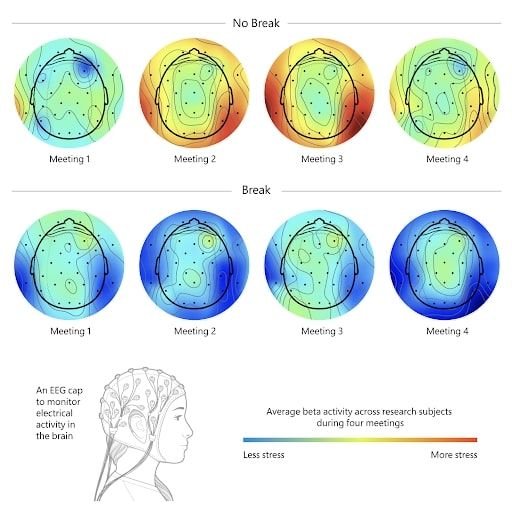
A 2021 study proves that moving directly from one meeting to the next increases employee stress and reduces performance. The brain must first complete a task and find distance before it can efficiently dedicate itself to other topics. Top tips: Take a 10-minute break between different video calls or other meetings. This is also essential for preventing burnout. Take breaks between different mental tasks and office work as well. Reframing: Value breaks away from the computer as an important part of your workday. Break activities are those that relax your mind, divert your attention from work, and direct your focus toward something you find relaxing. This can include short relaxation exercises, guided imagery, or short walks in nature. It is also beneficial to include 2–4 minutes of demanding physical activity between tasks and meetings to bring the pulse up to 110 beats (see https://osteopathie-liem.de/sitzpause/). Plan meetings consciously with agenda items and a short summary at the end, motivating as many participants as possible to take an active part. Image caption: For those who took breaks, average beta wave activity—associated with stress—remained largely constant over time; the low stress level is visualized here in shades of blue and green. For those who did not take breaks, average beta wave activity increased over time, indicating an increase in stress; this increase is shown here with a color shift from cool to hot. Illustration by Valerio Pellegrini. Legend: According to the study, employees who took regular breaks showed a positive asymmetry regarding their engagement. This means that their engagement increased over the course of the workday. In contrast, a negative asymmetry was found for employees who did not take breaks, meaning their engagement decreased during the day and they were more likely to withdraw. Illustration by Valerio Pellegrini. Here is a summary of the study: The study was conducted by the Microsoft Human Factors Lab and took place between March 8 and 18, 2021. A total of 14 individuals were examined while participating in video conferences wearing electroencephalogram (EEG) devices to monitor electrical activity in their brains. Participants were Microsoft and non-Microsoft employees from the US working in the information industry, typically working remotely. The study consisted of two different session blocks in which each participant took part. In the first session, half of the participants attended a series of four half-hour sessions, while the others had four half-hour sessions interrupted by 10-minute breaks during which participants meditated using the Headspace app. The following week, the groups were swapped so that each participant experienced both conditions. Each 30-minute meeting was accompanied by three to four additional non-EEG-measured volunteers to create a variation of participants working together to complete the assigned tasks. The tasks varied and included, for example, designing an office layout or creating a marketing plan. It is important to note that Headspace was not involved in the planning or execution of the study. Link: https://www.microsoft.com/en-us/worklab/work-trend-index/brain-research See also the book by Liem, Tsolodimos: https://amzn.to/3KwA3Ve






Radial Head Fracture: Osteopathic Treatment Step by Step
Torsten Liem, CEO of Osteopathie Schule Deutschland, is not only an expert in this field but also founded the Osteopathic Research Institute as well as