Summary
The technique for treating the solar plexus is based on the work of Robert Fulford and has been further developed in the context of psychosomatic osteopathy. The aim of the method is to regulate vegetative functions in general and in the abdomen in particular, to release emotional stress stored in the vegetative nervous system and to improve abdominal breathing.
The treatment involves gentle palpation, vibration and tissue perception in the area of the solar plexus. Indications include neurovegetative tension, therapeutic blockages, emotional trauma, respiratory and digestive disorders. The treatment process integrates conscious breathing, sensory awareness and manual techniques to release tension and harmonize the flow of energy in the body.
Keywords
solar plexus, solar plexus, psychosomatic osteopathy, autonomic nervous system, emotional stress, Fulford technique, palpation, vibration, tension release, breathing regulation
Abstract
The technique for treating the solar plexus is based on the work of Robert Fulford and has been further developed in the context of psychosomatic osteopathy. The aim of the method is to regulate vegetative functions in general and in the abdomen in particular and to release emotional stress stored in the autonomic nervous system. Furthermore, the procedure aims to improve abdominal breathing.
Treatment involves gentle palpation, vibration and tissue awareness in the solar plexus area. Indications include neurovegetative tension, therapy blockages, emotional trauma and respiratory and digestive disorders. The treatment process integrates conscious breathing, sensory awareness and manual techniques to release tension and harmonize the flow of energy in the body.
Keywords
Solar plexus, plexus solaris, psychosomatic osteopathy, autonomic nervous system, emotional distress, Fulford technique, palpation, vibration, tension release, breath regulation
Introduction
This technique, inspired by osteopathic teacher Robert Fulford, aims to regulate and harmonize the vegetative functions in the abdomen. I learned from Fulford to treat the solar plexus region with a vibrating device called a percussion hammer. The original technique was further differentiated, modified, expanded and embedded in a more comprehensive context within the framework of psychosomatic osteopathy [1].
According to Fulford, all biological impulses can be traced back to the basic functions of expansion and contraction. The parasympathetic nervous system promotes expansion, dilation, hyperemia, turgor and pleasure, while the sympathetic nervous system causes contraction, blood centralization, pallor, fear and pain, as well as the concentration of biological energy. The vegetative center of this energy is located in the abdomen, whereby the life process can be seen as a constant pulsation between parasympathetic expansion and sympathetic contraction.
Background
According to Fulford, the solar plexus can be regarded as the body’s emotional memory. To a certain extent, emotional traumas are stored in the vegetative nervous system at the solar plexus [2].
A disturbance of this pulsation, whether from the center to the periphery or vice versa, leads to an imbalance in the organism in the long term. Fulford emphasizes that chronic anxiety is often the trigger for sympathetic arousal, which is exacerbated by respiratory impairment due to abdominal tension. Anxiety often causes breathing to stop, resulting in incomplete and superficial exhalation and diaphragmatic fixation. These breathing patterns disrupt the coeliac ganglion and the flow of energy in the body, which can lead to physiological, emotional and structural changes.
It is currently assumed that the solar plexus acts relatively independently of both the central nervous system and the local neuronal control of the digestive organs, as an independent regulatory authority (4).
The treatment of the solar plexus in psychosomatic osteopathy therefore extends beyond Fulford’s observations. For example, the technique can also be applied in relation to the central role of the solar plexus in the regulation of digestive functions, as this plexus acts as an integrative switch point for the control of intestinal movements, secretion and absorption along the entire gastrointestinal tract. For example, solar plexus activity leads to increased sphincter contraction and reduced motility, decreased exocrine secretion and insulin secretion in the pancreas, and increased gluconeogenesis in the liver (4). These ganglia contain cell bodies of postganglionic sympathetic neurons. They specifically influence the visceral tissue via preganglionic acetylcholine-mediated and postganglionic noradrenaline-mediated signaling (5) and innervate, among others, the lower esophageal sphincter, the stomach, parts of the small intestine, the liver and the pancreas.
Indications
The technique is indicated for
- neurovegetative tensions,
- Therapy blockages,
- emotional stress,
- Dysfunctions of the diaphragm,
- Respiratory disorders and
- Digestive disorders.
Contraindications
Absolute contraindications include aortic aneurysm, acute abdomen, febrile illnesses, acute inflammatory organ diseases, thrombosis, renal colic, gastric bleeding, ileus, tuberculosis requiring treatment and abdominal pain of unexplained origin.
Procedure
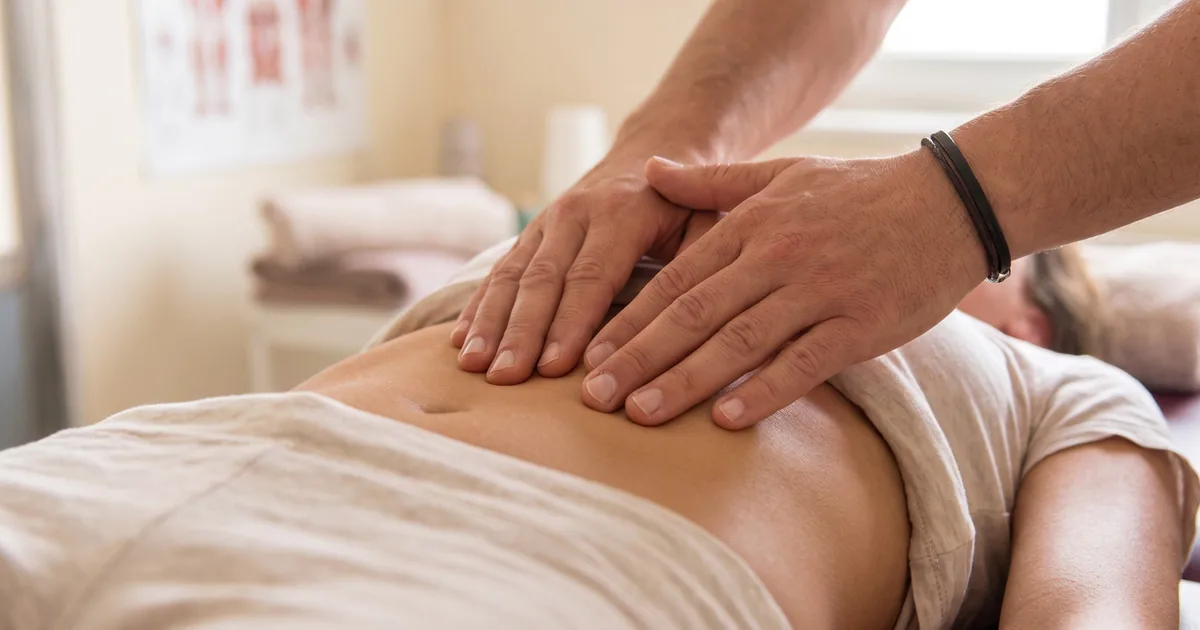
The therapist positions him/herself to the side of the patient at the level of the solar plexus. One or both hands are placed on the solar plexus, allowing the hands to gently sink into the depths. Gentle vibrations or following the tissue tensions are used to achieve a significant softening of the tissue.
Palpation approach
Palpate through the linea alba with diagonally positioned fingers on the region of the ganglion in question. Make gentle contact with the intraperitoneal ganglion in the area of the coeliac trunk. As the coeliac plexus is located dorsal to the lesser omentum, palpate slightly to the right of the center until the fingers perceive a pulsation (hepatic artery). A gentle, leftward pull on the curvatura minor of the stomach tenses the omentum minus and causes the pulsation to disappear. When the tissue tension decreases, the fingers can sink about 2 cm deeper to reach the region of the coeliac plexus.
Implementation
1. assessment of tension and strength
The osteopath assesses the softness, tension and firmness of the affected region through palpation and the patient’s perception. Softness can be assessed on a scale of 1-7, where 1 stands for “least soft” and 7 for “maximum softness”. Firmness is assessed on a scale from 0 to 10, where 0 stands for “soft” and 10 for “maximally firm”.
2. lower your hand into the depths
The therapist’s hand sinks gently into the depths and is “attracted” to the ganglion region. No pressure is exerted.
3. arriving without crossing the boundary of the fabric
The therapist allows the hand to sink into the tissue only as far as the natural resistance allows without exceeding the tissue boundaries.
4. focus the patient’s awareness on the abdomen
The patient is instructed to allow the breath to flow gently into the region of hand contact.
The therapist asks the patient what he/she perceives:
- locally in the area of hand contact: e.g. softness, permeability, temperature, tension, expansion etc.,
- in other areas of the body,
- Memories,
- Pictures,
- Emotions,
- Insights.
5. follow tension patterns and tensions
The therapist follows the tension patterns and tensions through gentle touch. This is done indirectly until no more tension is perceptible.
6. differentiation of the free rotation
The therapist checks the free rotation of the region:
- Clockwise and counterclockwise.
- From the outside in and from the inside out.
- Indirectly at the pace set by the body.
- This process is continued until the rotations and direction have changed or the rotation and movements have balanced each other out.
7. vibration
The therapist applies a gentle vibration in the direction of the firmness for a period of 2-6 minutes (Fig. 1). This vibration can also be intensified and supported using a massage gun (Fig. 2).
It is also possible, especially if the entire region is very firm, to start with vibration and then follow treatment steps 2-6.
The technique originally learned by Robert Fulford for the solar plexus consisted of using a so-called percussion hammer. This vibrates at the frequency of middle “C” on the piano. Fulford also frequently used the percussion hammer on one side of the body, while the transmission of its vibration frequency was observed on the opposite side of the body. Robert Fulford used this treatment instrument on patients of all ages, including infants.
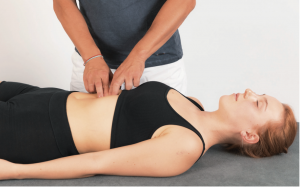
Fig. 1: Gentle vibration in the direction of firmnessFig. 2: Vibration supported and intensified by a massage gun
8. retrieve and anchor the patient
The therapist helps the patient to return to the present moment and anchor the positive experience (with softness of 6-7 or firmness of 1-2). This is done through gentle butterfly tapping. The patient crosses their arms over their chest as if they were hugging themselves and taps their upper arm alternately left and right with their hands about 20 times at a comfortable speed [3].
Additional information for the treatment process
Throughout the treatment, it is important to actively incorporate the patient’s experience. This improves relaxation, access in everyday life and mapping of the tissue through the patient’s focused perception.
For example, the progression of the change on the part of the patient in relation to the softness or firmness in the upper abdominal region can be queried again (see point 1) and questions about the perception of the overall experience can be asked.
Other ways to support relaxation include directing the breath into the contact region as well as sighing, sounds and bilateral music with alpha waves (e.g. “Grounding waves” by Torsten Liem) and many other co-regulations [1]. Open or closed eyes and slow saccades with the eyes can also be helpful. The vagus nerve can be activated by touching the concha auricularis, for example. The exact zone is located at the end of the crus helicis.
Observational focus of the therapist
The therapist should continuously pay attention to the following aspects during treatment:
- Breathing of the patient,
- Facial expression and expression,
- changes in tissue tension, – sweat production,
- Abdominal noises.
If possible, the pulse or heart rate variability can also be measured.
This detailed observation enables precise and sensitive execution of the technique, which aims to relax the solar plexus.
Literature
- Liem T. Psychosomatic osteopathy. Osteopathic Medicine 2023, 24(4), 2-7.
- Fulford RC. From center to periphery. AAO Convention. 1980; (11).
- Girianto, Pria, Widayati, Dhina, Agusti, Syahdila. (2021). Butterfly Hug Reduce Anxiety on Elderly. Jurnal Ners dan Kebidanan (Journal of Ners and Midwifery). 8. 295-300. 10.26699/jnk.v8i3.ART.p295-300.
- JOHN, R. S., Dixon, B., Hendrix, J. M., & Shienbaum, R. (2024). Celiac plexus block. InStatPearls. StatPearls Publishing.
- McCorry LK. Physiology of the autonomic nervous system.Am J Pharm Educ. 2007 Aug 15;71(4):78