Summary
Aetiological factors, risk factors and mechanisms of action of complaints, healing reactions and somato-physiological experience-context dysfunction patterns characterize the specific treatment approaches within the framework of psychosomatic osteopathy (PSO). The case study of an athlete who has suffered a loss of performance is intended to illustrate the therapeutic principle of PSO.
Keywords
Person-context relationship, adaptivity, proactivity, dysfunction dynamics, co-regulation and feedback loops, somatic dysfunction
Abstract
Etiological factors, risk factors and mechanisms of action of afflictions, healing reactions and somato-physiological experience-context-dysfunction patterns characterize the specific treatment approaches within the framework of psychosomatic osteopathy (PSO). The case study of an athlete who suffered performance losses is intended to exemplify the therapeutic principle of PSO.
Keywords
person-context relationship, adaptivity, proactivity, dysfunction dynamics, coregulation and feedback loops, somatic dysfunction
A patient came to the practice due to reduced performance in a half marathon and increased sleep bruxism. These had been occurring for several months.
The patient showed slightly reduced receptor afferentation in the dermatome field of the femoral nerve of the right leg and minimally reduced strength of the rectus femoris muscle. This could be an explanation for possible losses in various cerebral mapping, with the possible consequence of reduced neuronal resilience of the femoral nerve, altered arthrokinematic reflex activity, force transmission and fascial tension of the right leg, which manifested itself in the slowing of its walking times.
The findings in the inguinal ligament were unremarkable; no possible bottlenecks were found. The right psoas muscle showed restrictions in extension and a slightly increased tone.
Could this explain the loss of the femoral nerve? Was this the cause and could the problem be solved by neuronal relief and treatment of the psoas muscle?
Further examination revealed significant pressure pain in the terminal ileum, the iliocecal valve, the region of the caecum and the inferior ascending colon.
Was this the cause of the increased psoas tension, the restriction of extension in the right hip and visceral treatment indicated?
The microbiome examination revealed significantly increased alpha-1-antitrypsin levels and greatly reduced levels of the gram-negative bacterium Akkermansia muciniphila.
So is probiotic treatment indicated?
His very good eating habits were noticeable, apart from – for about 5 months – an evening consumption of half a bottle of red wine and two bars of chocolate.
So should a nutritional intervention be carried out?
Since otherwise no sugar and hardly any cereal products were consumed, this is more indicative of emotional neediness, which became apparent in the evening, than of leptin or insulin resistance. In fact, his long-term partner separated from him 6 months ago. This led to an emotional distress score of 9.5 out of 10, a numerical feedback scale for subjective self-assessment of distress intensity by patients ranging from no distress (NFS = 0) to maximum imaginable distress (NFS = 10). When asked, he confirmed nocturnal acid regurgitation and burning behind the sternum for several months. Reflux can lead to sleep bruxism with a prevalence of 74%.
The diagnostic question I asked myself was: Which systems and functional units show a loss of adaptive capacity, and are these still functional or already anatomical? Which contexts could possibly play a role in this? What are the specific dysfunctional mechanisms of action – the big players – in this patient? Which osteopathic approaches could enable an improvement of flexibility in the patient?
The palpatory approach is based on the four-level focus:
- Clinical reasoning: Recognition pattern diagnostics is based on the synthesis, constant reflection and internalization of past clinical experiences.
- Open Mind: The focus here is on openness to the fact that the therapist is not yet aware of any kind of interrelationships in this individual patient and that they could be important for healing.
- Open Heart: This refers to empathic perception, “compassion”, so that the inner and outer world can be experienced by the therapist through the eyes of the patient.
- Here and now: The ability to locate attention and intention in the here and now means directing as much of the physiology and the afferent and efferent contents of consciousness as possible to the treatment interaction with the patient.
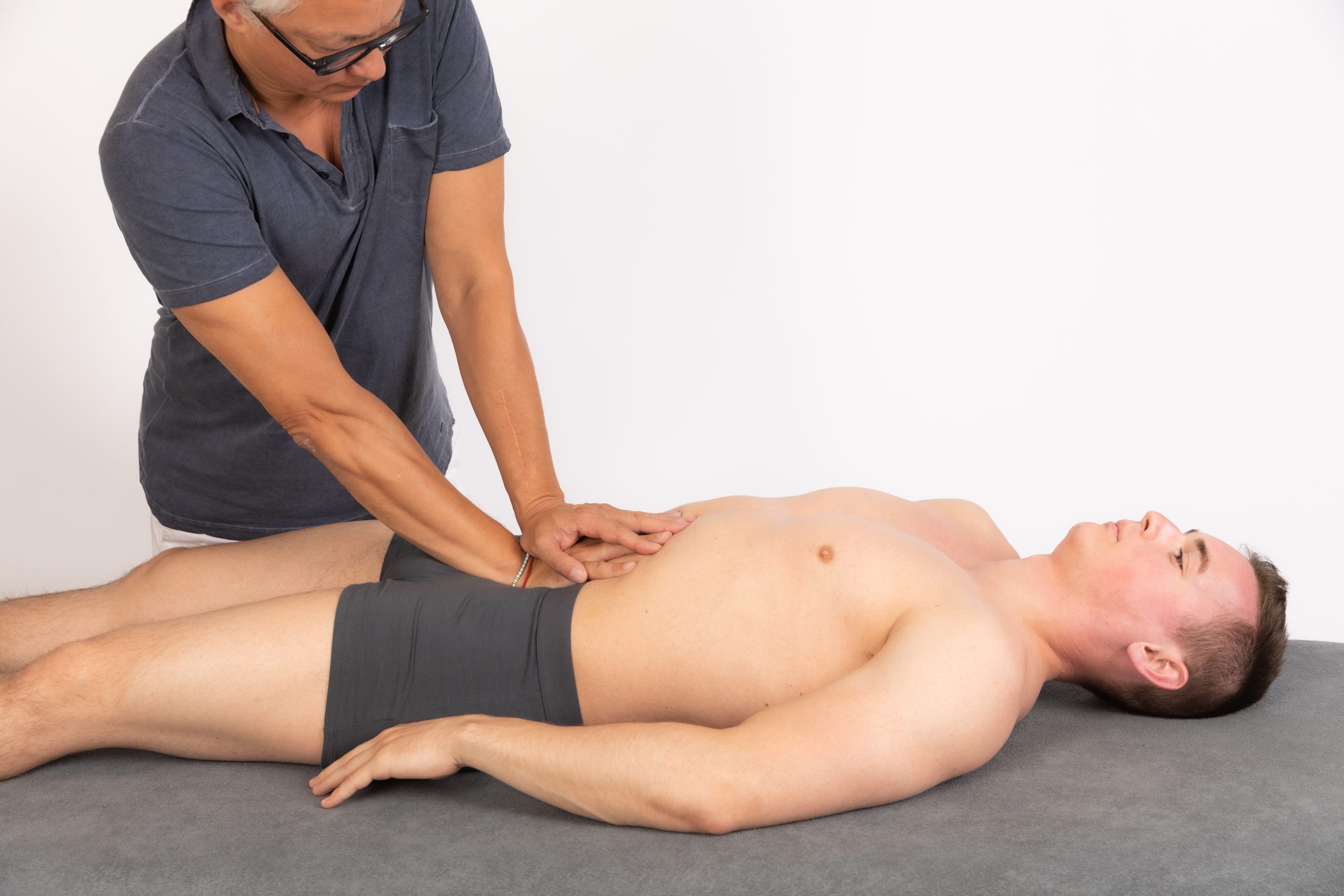
Finally, the patient was treated in three sessions using multimodal bifocal integration, in the course of which the emotional load was reduced to 2 out of 10. His evening consumption of red wine and chocolate was reduced quite quickly. In addition, the hip, the psoas muscle, the right intestinal region, the oesophagus and a dysfunctional utriculus were treated.
His afferents in the dermatome of the right femoral nerve normalized within 1 month and his walking times within 3 months. The sleep bruxism was also significantly reduced.
Of course, the correlation of findings that I described above can also be coincidence and based on apparent causality. Clinicians live with this.
But is it always that simple and clear? Certainly not.
However, the identification, differentiation and relativization of clinical patterns, the inclusion of contextual factors, the reduction of risk factors, the inhibition of dysfunctional patterns, the promotion of resources and the proactivity of the patient often allow a profound and lasting improvement.
I sincerely wish you much fulfillment and success in your practice.