Anuloma viloma, or alternate nostril breathing, is the most commonly used pranayama exercise (control of life energy through breathing exercises). Anuloma viloma modulates cardiovascular control and brain activity and leads to an alert and focused state. This is associated with an increase in alpha, beta and gamma wave activity and an increase in heart rate variability (Malhotra et al. 2022).
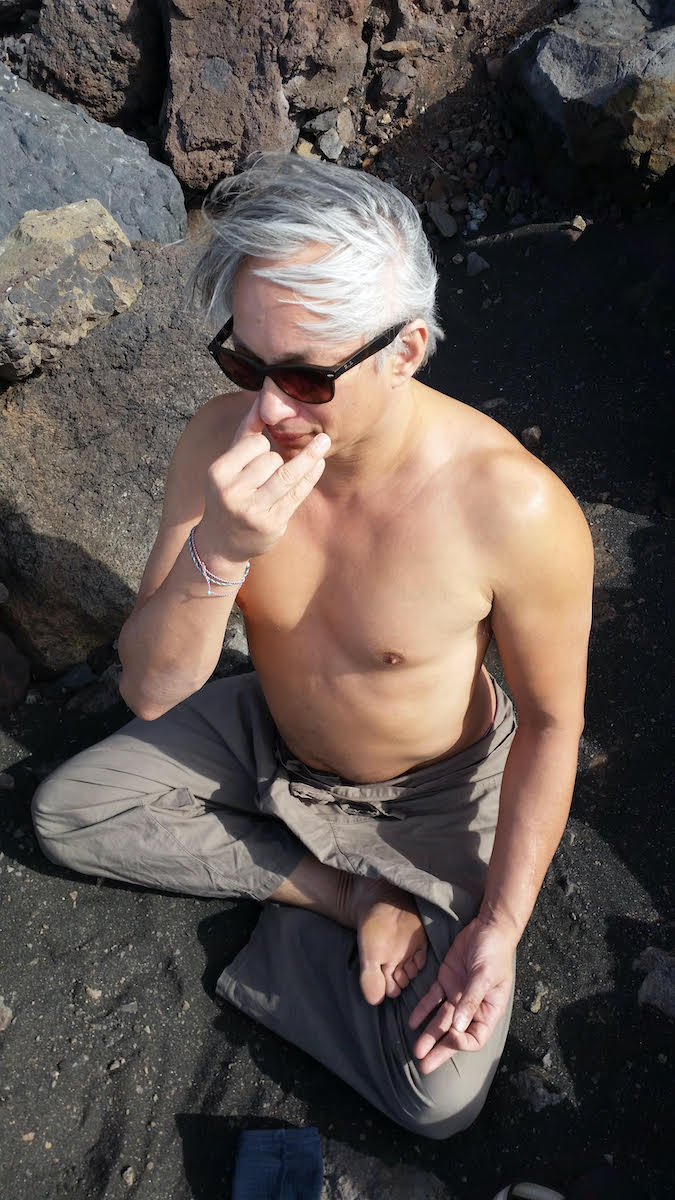
Anuloma viloma (alternate nostril breathing) – an exercise for harmonization and calming:
Instructions: Anuloma viloma (alternate nostril breathing)
Close the right nostril with the thumb of your right hand.
Stand upright, with your feet about shoulder-width apart. Inhale through the left nostril for a count of 5–10.
Stand upright. Use the ring finger and little finger of your right hand to close the left nostril.
Exhale through the right nostril for a count of 5–10.
Inhale through the right nostril (the ring finger and little finger continue to close the left nostril).
Close the right nostril with the thumb of your right hand.
Exhale through the left nostril.
Repeat this cycle for 5–10 minutes.
After some practice, you can also try to lengthen the exhalation, e.g., inhale for a count of 5 and exhale for a count of 10. Pay particular attention to keeping the mouth, jaw, eyes, and abdominal area relaxed.
Important: Inhalation and exhalation should feel very pleasant. You should never experience a feeling of shortness of breath. The inhalation and exhalation should be the same length and can be shortened or lengthened according to your own capacity.
Malhotra V, Deep A, Javed D, Singh R, Wakode S, Bhagat OL, Porter PK. Slow Frequency Anuloma Viloma Pranayama Modulates Cardiac and Neural Oscillations in Yoga Practitioners. Mymensingh Med J. 2022 Jul;31(3):851-860.
https://pubmed.ncbi.nlm.nih.gov/35780374/
Order The Osteopathy Self-Help Book directly from Amazon
The latest book by Torsten Liem. The author is known and respected for his well-founded professional books; he has also had osteopathy guides/non-fiction books on the market for more than 20 years.