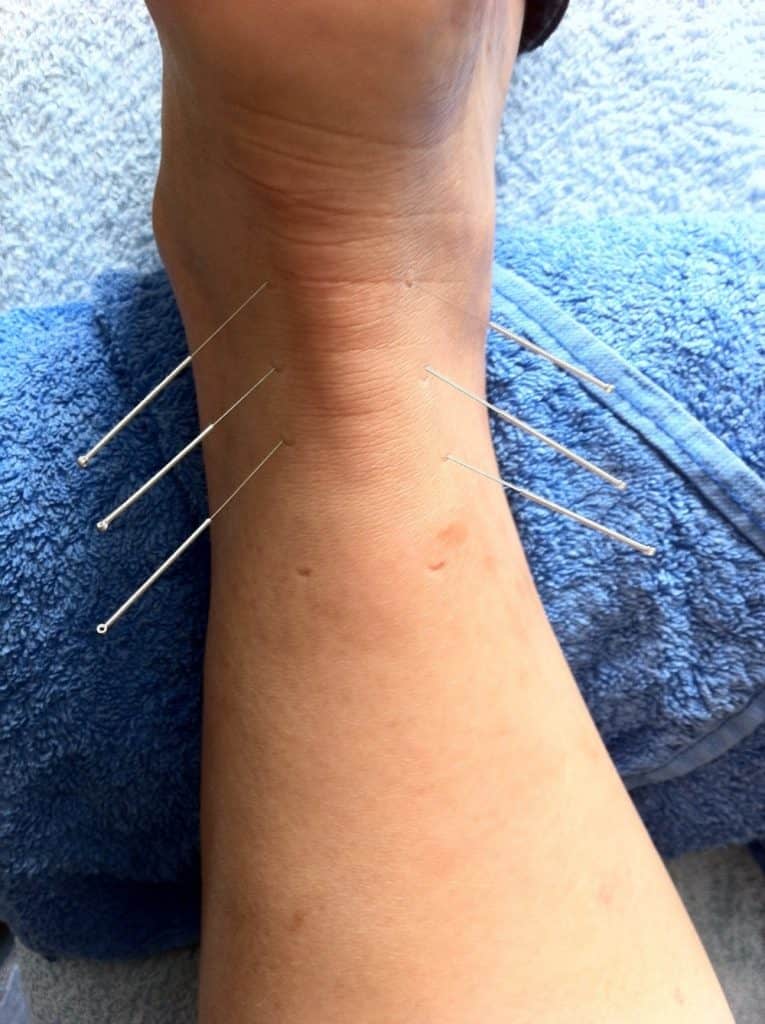
Dry needling is a specialized acupuncture technique for the treatment of myofascial (muscular and fascial) trigger points. The principle of action is based on direct insertion into the trigger point (Lewit 1979). There are two different forms of dry needling. In this article, we would like to focus on the so-called intramuscular stimulation (IMS), where the needle is inserted directly into the myofascial trigger point. The difference from classical acupuncture is that the needles are inserted directly into the myofascial trigger point and not into the Qi-regulating meridians.
Mechanism of Action
Through the development of a microanalytical system capable of measuring the biochemical milieu of human muscle, new insights into the mechanisms of long-lasting muscle pain have become possible. For instance, Shah et al. were able to show that in neck pain triggered by trigger points, the concentrations of protons, bradykinin, calcitonin gene-related peptide (CGRP), substance P, tumor necrosis factor-α, interleukin-1β, serotonin, and norepinephrine are significantly increased, and the pH value is decreased compared to patients without pain (Shah et al. 2005). Conversely, intramuscular stimulation using dry needling leads to a normalization of the local biochemical milieu of the myofascial trigger point (Shah et al. 2008).
Effectiveness/Efficiency
In a recent study, the pain-relieving effect of dry needling into the trigger points of the sternocleidomastoid muscle was demonstrated in migraine patients. Headache frequency, intensity, and duration were significantly reduced through three sessions (Rezaeian et al. 2020). Another systematic review examined the effectiveness of the dry needling technique in treating spasticity in individuals following a stroke. Data from a total of 221 patients were analyzed, and a significant decrease in spasticity was observed, although the certainty of the evidence was low (Núñez-Cortés et al. 2020). This was further supported by another systematic review from 2021. The authors investigated the effectiveness of dry needling on spasticity and range of motion and found strong evidence for the efficiency of this procedure (Bynum et al. 2021). BibliographyBynum R, Garcia O, Herbst E, et al. Effects of Dry Needling on Spasticity and Range of Motion: A Systematic Review. Am J Occup Ther. 2021;75(1):7501205030p1-7501205030p13Lewit K. The needle effect in the relief of myofascial pain. Pain. 1979;6(1):83-90Núñez-Cortés R, Cruz-Montecinos C, Latorre-García R, et al. Effectiveness of Dry Needling in the Management of Spasticity in Patients Post Stroke. J Stroke Cerebrovasc Dis. 2020;29(11):105236Rezaeian T, Mosallanezhad Z, Nourbakhsh MR, et al. Effects of Dry Needling Technique into Trigger Points of the Sternocleidomastoid Muscle in Migraine Headache: A Randomized Controlled Trial. Am J Phys Med Rehabil. 2020;99(12):1129-1137Shah JP, Gilliams EA. Uncovering the biochemical milieu of myofascial trigger points using in vivo microdialysis: An application of muscle pain concepts to myofascial pain syndrome. J Bodyw Mov Ther. 2008;12(4):371-384Shah JP, Phillips TM, Danoff J V., et al. An in vivo microanalytical technique for measuring the local biochemical milieu of human skeletal muscle. J Appl Physiol. 2005;99(5):1977-1984